Category: Editor Tips

  • How To Stay Motivated When Things Slow Down

    How To Stay Motivated When Things Slow Down

    Creating the perfect family cookbook is not happen overnight. It takes commitment, organization, and lots of photos and recipes to create a treasured keepsake that will last generations. Staying motivated is one of the toughest things about any long-term project like creating a cookbook.

    Sometimes life gets in the way of our best intentions. We have other obligations to fulfill that make your initial expectations extend out longer than expected.

    Here are some of the things you can try when your cookbook seems to be stuck in neutral.

    Don’t try to do it all yourself – FamilyCookbookProject.com has a built-in tool to invite other family members to contribute recipes to your cookbook. Having additional people to add recipes makes the work go faster.

    Add a co-editor – sometimes sharing the work means getting someone else to review the recipes and check for typos. This is a time consuming task that maybe you can assign to someone else in the family.

    Keep it simple – FamilyCookbookProject.com has powerful tools to allow you to personalize your family cookbook in almost any way you can imagine. However you don’t have to use them all. I consider using one of our professionally designed cookbook covers rather than creating your own. Using standard recipe layouts also can save time and energy.

    Make a To do list – it’s always best if you know what tasks have to be completed in order to finish your cookbook. Take a look at the blog post 7 Steps to Create a Perfect Family Cookbook to see all the steps and know what still has to be done.

    Scale back expectations – sometimes our vision for our family cookbook does not meet the reality of what the publishing system will allow. Be flexible enough to reset your expectations of what you want your cookbook to look like in order to keep the project moving forward.


    Bill Rice is Co-Publisher of the Great Family Cookbook Project, a website that helps families and individuals collect and share food memories by creating their own printed personal cookbooks. Follow us on Facebook, Instagram and Pinterest!

  • Subscribe to the Family Cookbook YouTube Channel

    Subscribe to the Family Cookbook YouTube Channel

    Our job at Family Cookbook Project is to make the process of creating your own personal cookbook as easy as possible for you, our editors.

    That’s why we recently added the “How-To” section of FamilyCookbookProject.com with step-by-step directions to some of your most common requests. You’ll find it the second option in the black navigation bar along the top of every page of the site.

    However we also know that seeing can be easier to understand  that reading. That is why we offer the Family Cookbook Project YouTube Channel.

    We have started creating a series of video walk throughs to help you see how some of the tools are used in FamilyCookbookProject.com.

    • How to get started  – This tutorial walks you through the steps needed to create your FamilyCookbookProject.com account and takes a quick look at your editors account.
    • Editor Homepage Intro – Take an introductory video tour of the family Cookbook Project editor’s homepage and see all of the options available to create your own personal cookbook.
    • How to select a cookbook cover – Family Cookbook Project has an entire library of professionally designed cookbook covers that you can use on your custom cookbook. This tutorial show you have to select the cover that is right for you. Future tutorials will cover how to create a custom cover for your personal cookbook.
    • How To Use Custom Categories – Custom Categories allow Family Cookbook Project editors to change the default recipe categories in their cookbook to be personalized for their needs. It offers the flexibility to create your own custom recipe book the way you want it to appear.

    In addition to the How To videos, we also have a Features and Benefits Playlist which will show videos we use to promote FamilyCookbookProject.com and show why creating a custom recipe books is a great idea. Here are the first videos in the Features and Benefits playlist:

    Please let us know how you like these videos and what topics you’d like to see covered. Also you can help us by subscribing to the FamilyCookbookProject.com YouTube Channel and have any new videos delivered directly to your video feed.


    Bill Rice is Co-Publisher of the Great Family Cookbook Project, a website that helps families and individuals collect, preserve and share food memories by creating their own printed personal cookbooks. He is the author of The Wellfleet Oyster Cookbook (Available on Amazon) and the Cape Cod Cocktail Cookbook, both created using FamilyCookbookProject.com. He is also editor of the Donovan Family Cookbook, now it’s third printing.

    Follow Family Cookbook Project on Facebook, Instagram and Pinterest!

  • Why Your Cookbook Needs Blank Pages

    Why Your Cookbook Needs Blank Pages

    One of the questions we at FamilyCookbookProject.com get a lot is “Any way to remove blank pages that I will be charged for in printing?”

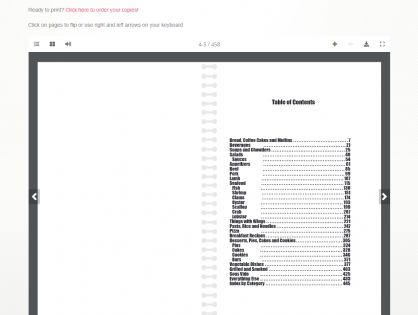
    While removing a few extra pages might save you a few pennies when printing, almost all blank pages are needed. In the publishing world, certain pages need to start on the right side of a two page layout.  The Table of Contents and Category Dividers are two examples of these types of pages that always are placed on the right side of a two page layout.

    If you run your preview and look at the 3D Preview, you’ll see that almost all blank pages are the end of sections to leave the new sections to start fresh.

    In terms of the recipes categories, if the last page of a recipe category is blank, that page was placed there so as to have the next category starts on the right page side. However, if you add additional recipes to that first section, the blank page may come and go depending on the number of recipes in the section.

    You have an option of adding a photo using the Cookbook Picture Manager or a custom page using the Custom Pages Tool to the “end” of any recipe section. That can help fill the blank page. However, if you have not finished the section and add/edit recipes, you may end up with a blank page after your photo/custom page, so wait until all of your recipes are added before considering adding any custom pages.

    Another way to eliminate blank pages on the back of recipes dividers is to include our “Helpful Tip” content on the back of the dividers or to add family photos and set the location in the Photo Manager Tool to the back of the divider.

    You also have the option to start the recipes on the back of the divider. This is done in the Layout and Design Center of your editors homepage. Select “Select Dividers” from the Frist Steps section and check the box for “Start recipes on divider back.” This is also where you can turn on and off “Helpful Tip”.


  • How to Motivate Your Family Cookbook Recipe Contributors

    How to Motivate Your Family Cookbook Recipe Contributors

    As with any family project, getting everyone to contribute can be a challenge, especially if they have not seen the end product beforehand.

    Here are some tips to keep your Family Cookbook Project contributors motivated:

    The more the merrier – Be sure to include everyone, not just the great cooks. Everyone likes to be asked to participate and the more you invite, the more recipes you’ll likely get. To add contributors and send an email invitation, > Use the Invitation Tool

    Set a reasonable deadline – Set the submission deadline on the “Project Information Editor” page, but don’t set it too far in the future. We all tend to put off whatever we can and contributing recipes is often one of those things. A month is usually enough time to give everyone to find the recipes they want to contribute and get them entered. Two things to remember: most of the recipes will come in just in time for the deadline and second, you can always extend the deadline if you want more recipes.

    Send regular updates – Use the Reminder Tool to email some or all of your contributors on a regular basis. Remind them of the deadline and ask them to meet a specific goal, like “please add one or two recipes to each category”.

    Target the biggest recipe boxes – Every family has a handful of people who are known for their cooking (you are most likely one of them in your family!). Send a personal message to them either using the remainder tool or reaching out by telephone, Facebook or with a personal visit. People are flattered when their skills are recognized. Let them know the cookbook would not be complete without their contributions.

    Ask for specific recipes – Send a reminder to everyone asking for a specific recipe from your family’s past that will get everyone thinking of past gatherings. Include your memories of that dish or the person who created it. It might help remind everyone why putting together a family cookbook is important.

    Use social media – As you add your own recipes to your family cookbook, it is easy to post them to Facebook or pin them to Pinterest. Sharing your recipes this way shows other family members that you are contributing and shows them they should as well.


    Bill Rice is Co-Publisher of the Great Family Cookbook Project, a website that helps families and individuals collect, preserve and share food memories by creating their own printed personal cookbooks. He is the author of The Wellfleet Oyster Cookbook (Available on Amazon) and the Cape Cod Cocktail Cookbook, both created using FamilyCookbookProject.com. He is also editor of the Donovan Family Cookbook, now it’s third printing.

    Follow Family Cookbook Project on Facebook, Instagram and Pinterest!
  • What To Do Once You’ve Printed Your Personal Cookbook

    What To Do Once You’ve Printed Your Personal Cookbook

    You’ve done it. You have collected your recipes, got others to contribute their recipes, picked a cover and recipe layouts and used FamilyCookbookProject.com to publish your very own cookbook.

    Now what?

    The good news is just because you publish your first cookbook doesn’t mean that you have to be done.

    Here are some ideas on how to continue using your FamilyCookbookProject.com account

    Online recipe box. Many people find that they continue adding new recipes to their account even after publishing and printing their personal cookbook. It’s easy to add recipes and it’s convenient to have them all in one place.

    Use the mobile app – Access to your online recipes is only a few clicks away with the award-winning Family Cookbook Project mobile app for both Apple iPhones and android devices.

    Print a second volume for your family cookbook – Often times once a book is printed new people see its value and want to contribute recipes. Creating a second volume for your family cookbook is a great way to get additional people involved and to keep the project alive.

    Create a Best of cookbook – Our family cookbook has over 250 recipes but I personally have about 50 that I like cooking all the time. I created a separate cookbook just of my go to recipes which allows me to find what I’m looking for so much quicker. I printed one copy and keep it right into the kitchen where I can find it quickly.

    Create a personal cookbook – If you have created a family cookbook, you were allowed only to include so many of your recipes in order to give everyone a chance to participate. Consider creating a cookbook with just your recipes which will allow you to enter many more then or in the family cookbook.


    Bill Rice is Co-Publisher of the Great Family Cookbook Project, a website that helps families and individuals collect, preserve and share food memories by creating their own printed personal cookbooks. He is the author of The Wellfleet Oyster Cookbook (Available on Amazon) and the Cape Cod Cocktail Cookbook, both created using FamilyCookbookProject.com. He is also editor of the Donovan Family Cookbook, now it’s third printing.

    Follow Family Cookbook Project on Facebook, Instagram and Pinterest!
  • Using Custom Recipe Layouts in a Family Cookbook Project

    Using Custom Recipe Layouts in a Family Cookbook Project

    One of the things that we are most proud of at FamilyCookbookProject.com is the ability to give complete control of every aspect of making a cookbook to the project’s editor. We provide professionally designed options that are perfect for most people, but some have visions of something different.

    We have already covered creating custom categories and custom cookbook cover or recipe category dividers. This article will cover creating a custom cookbook recipe layouts.

    FamilyCookbookProject.com currently offers 19 pre-set recipe layouts that set three aspects of your recipes that are perfect for most editors:

    • Font type
    • Font size
    • Number of columns for ingredients

    However if you want something different, that is where custom Layouts come in. You can control each section independently – title, contributor name, ingredients, directions and personal notes.

    In addition to the font type, size and columns above, you also can control:

    • Bold text
    • Italic text
    • Justification of text
    • Label of the Comments Field

    This option is not for someone who does not have strong computer skills, but it can be very effective in displaying your recipes exactly how you wish them displayed.


    Bill Rice is Co-Publisher of the Great Family Cookbook Project, a website that helps families and individuals collect, preserve and share food memories by creating their own printed personal cookbooks. He is the author of The Wellfleet Oyster Cookbook (Available on Amazon) and the Cape Cod Cocktail Cookbook, both created using FamilyCookbookProject.com. He is also editor of the Donovan Family Cookbook, now it’s third printing.

    Follow Family Cookbook Project on Facebook, Instagram and Pinterest!

  • Add a Family Directory to Your Family Reunion Cookbook

    Add a Family Directory to Your Family Reunion Cookbook

    Family reunions are a great opportunity to create a family cookbook and get lots of people to participate. A family reunion cookbook motivates family members to communicate before the event and helps get everyone excited!

    At FamilyCookbookProject.com, We have hundred’s of family reunion cookbooks under our belts and we’d love to work on yours. Our site is perfect for communicating with larger groups of family members via email and keeping everyone motivated.

    Here is a fun idea for your Family Reunion Cookbook – a family directory section!

    Here’s how to do it:

    • Start by creating a custom recipe category entitled “Family Members”.
    • Next, add your family member’s names and email addresses into the invitation tool so you can invite them to participate and directly add recipes and bios to your cookbook account.
    • Next ask everyone to use the add a recipe tool and have them enter their name as the title of the recipe, Their photo as the recipe photo and their bio as the personal notes. They can leave everything else blank and all of the bios will be together in one section in the back of the book.

    You might want to also include a family tree so everyone knows how each other is related.

    The other way to create a family directory would be to have everyone email you their info and photo and you create custom pages for each one.

    Family members can even pick up the cookbooks at the reunion!


    Bill Rice is Co-Publisher of the Great Family Cookbook Project, a website that helps families and individuals collect, preserve and share food memories by creating their own printed personal cookbooks. He is the author of The Wellfleet Oyster Cookbook (Available on Amazon) and the Cape Cod Cocktail Cookbook, both created using FamilyCookbookProject.com. He is also editor of the Donovan Family Cookbook, now it’s third printing.

    Follow Family Cookbook Project on Facebook, Instagram and Pinterest!
     

  • Cookbook Themes Introduced to FamilyCookbookProject.com

    Cookbook Themes Introduced to FamilyCookbookProject.com

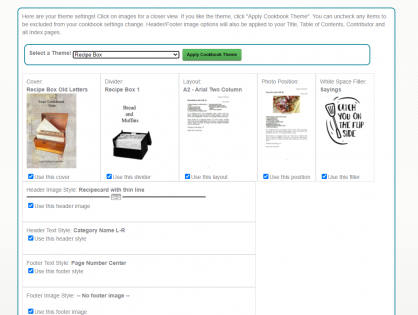
    When starting our designing your own personal cookbook on FamilyCookbookProject.com, you have a bunch of design choice to make. While many people simply use the default options included automatically when you create your account (these are based on the most popular design selections). We wanted to give new editors a simple way to create a coordinated look and feel for their cookbook, that is why we have created “Cookbook Themes”.

    Available as the first option in the First Steps section of the Design Center, the 7 themes currently available combine selections for cover, divider, recipe layout, photo position and white space filler along with header and footer options to create a synchronized design for your cookbook.

    Options include Rolling Pins, Farm to Table, Food Love, Holiday Baking, Recipe Box, Recipe Family Tree and Wedding.

    If you do not like one of the options of the theme, you can unselect that option and choose other from our available selections. As always, you change your mind and change any aspect of the theme up until you place your order to print your cookbook. Nothing is locked in.

    Check the theme options in your Editor Design Center.


    Bill Rice is Co-Publisher of the Great Family Cookbook Project, a website that helps families and individuals collect, preserve and share food memories by creating their own printed personal cookbooks. He is the author of The Wellfleet Oyster Cookbook (Available on Amazon) and the Cape Cod Cocktail Cookbook, both created using FamilyCookbookProject.com. He is also editor of the Donovan Family Cookbook, now it’s third printing.

    Follow Family Cookbook Project on Facebook, Instagram and Pinterest!
     

  • FamilyCookbookProject.com Expanding Layout Options

    FamilyCookbookProject.com Expanding Layout Options

    FamilyCookbookProject.com is once again expanding the layout options available to our editors. We are constantly listening to what our editors are asking for and if someone has a good idea, we like to offer it to the entire community. Here are some of the things that were recently added:

    White Space Filler Options

    We have introduced 5 new white space filler graphic packages:  Beach, Cute Sayings, Baking, Farm, and Wedding. These new offering join the 6 original filler packages and the system automatically adds the images or text whenever there is enough white space at the bottom of a recipe or custom page if this option is selected.

    White space filler options now also have a quick preview so you can see the options in the package. Click on the (Sample) after the package name to see the items in the package.

    Header and Footer Artwork

    One of our goals for a long time was to add the ability to add design elements to the top (header) and bottom (footer) of recipes and other pages in the cookbook. I’m please to announce that this is now available!

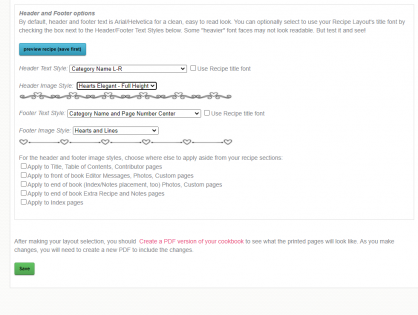
    In your quick start editor view, click on the “recipe Layout” option in the Layout and Design Center. Then scroll down to the section for “Header and Footer options”.

    Here you will find the ability to control how your page is laid out. For example, you can have your recipe category name and page number centered or in the corners of each page for both the top and bottom of the page. By clicking on the blue preview button, you can see how you choice changes the page (make sure to save first).

    Also added is a collection of design elements that can add fun graphics to your recipe page. Images like double lines, single line with recipe card, line with rolling pin are now available.

    The default text style uses the same smaller Arial as in the past, but we’ve added a check box to use your recipe title font face instead of the default font.

    The above initially affect your recipe sections only, but there are 5 checkbox options for incorporating these design images to other sections of the cookbook, like index, title page, table of contents, custom pages and more.

    As always, make sure to save your work before moving to a new page or task.


    Bill Rice is Co-Publisher of the Great Family Cookbook Project, a website that helps families and individuals collect, preserve and share food memories by creating their own printed personal cookbooks. He is the author of The Wellfleet Oyster Cookbook (Available on Amazon) and the Cape Cod Cocktail Cookbook, both created using FamilyCookbookProject.com. He is also editor of the Donovan Family Cookbook, now it’s third printing.

    Follow Family Cookbook Project on Facebook, Instagram and Pinterest!
  • Anatomy of a Great Recipe

    Anatomy of a Great Recipe

    One of the keys to a great family cookbook is to have great recipes that your family and friends have come to love. Here are some simple tips to help you capture the magic of the food you make.

    1. Use catchy titles. Using a catchy title will make your recipe sound more interesting. It is more interesting to people when they see the title “Gooey Triple Chocolate Cake” rather than just “Chocolate Cake”. When you are writing a title for a recipe, try to think of not only what the final dish will be, but what makes it special as well.

    2. Include photos. Using images in your recipes can allow the person reading your cookbook to see what the final dish will look like and give then a guidepost to follow. Next time you make one of your special dishes, snap a quick photo and add it to your recipe the next time you log in.

    3. Be specific with your Ingredients. For many cooks, include a can of crushed tomatoes in your recipe and they know exactly what you mean or maybe not. Tell them to include a 12oz can of crushed tomatoes and everyone will know exactly what your recipe needs.

    4. Use step by step instructions. You might have made this recipe a thousand times, but someone new will need detailed directions for how to do it. Remember to include pan sizes, cooking times, the order that ingredients are added and how to tell when a dish is done. Also adding how many servings a recipe can make will help with meal planning.

    5. Add personal notes. One of the things that make a family cooks so important is that it helps to capture the family traditions. Include a note with each recipe about how you first were introduced to the recipe and when it is typically served in your household. It makes the recipe more interesting and more meaningful to later generations.


    Chip Lowell is Co-Publisher of the Great Family Cookbook Project, a website that helps families and individuals collect and share food memories. Follow Family Cookbook Project on Facebook, Instagram and Pinterest!