Category: Editor Tips

  • Pro Tip: Delete A Photo From A Recipe

    Pro Tip: Delete A Photo From A Recipe

    Go to the edit recipe page with the photo and click on the “[Edit Photo]” link beneath the photo. Here you will find a delete button.

    If you upload a new photo, it will also automatically delete the old one.

    If you have more than one photo to edit or remove, you can also go to Editor Activities>Quick Start.  Click Photos under the Recipe box to do the same thing, but from the photo list instead of recipes.

    Bill Rice is Founder and Co-Publisher of the Family Cookbook Project, the leading online cookbook publisher with a website that helps families and individuals collect, preserve and share food memories by creating their own printed custom cookbooks. He is the author of The Wellfleet Oyster Cookbook and the Cape Cod Cocktail Cookbook (Available on Amazon), both created using FamilyCookbookProject.com. He is also editor of the Donovan Family Cookbook, now it’s third printing and is an avid genealogist tracing his family back to the 1600’s.

    Follow Family Cookbook Project on Facebook, Instagram, Twitter TikTok, YouTube and Pinterest!

  • You’re Closer Than You Think: How to Finish Your Family Cookbook in Just a Few Simple Steps

    You’re Closer Than You Think: How to Finish Your Family Cookbook in Just a Few Simple Steps

    Let’s be real for a minute.

    Starting a family cookbook feels exciting. You gather favorite recipes. You think about Grandma’s meatballs, Aunt Linda’s sugar cookies, Dad’s chili, and that one mystery casserole everyone loves but no one can explain. You picture a beautiful printed cookbook sitting on the kitchen counter, ready to be used, shared, splattered, loved, and passed down.

    Then life happens.

    The cookbook sits unfinished.

    Maybe it has been a few months. Maybe it has been a few years. Maybe you started it with great hope, then got distracted by work, family, holidays, laundry, taxes, or the fact that dinner still expects to be made every night. Rude, honestly.

    But here’s the good news: you are probably much closer to finishing your family cookbook than you think.

    You do not need to create a perfect cookbook. You do not need every recipe your family has ever made. You do not need a museum-level archive of culinary history. You just need to take the next few steps.

    And once you do, you can turn your saved recipes into a printed cookbook your family will hold, use, and treasure.

    So grab your coffee. Or tea. Or the last cold sip of yesterday’s coffee, because we are not judging here. Let’s walk through how to finish your family cookbook without stress, drama, or a three-ring binder full of panic.

    First, Let Go of “Perfect”

    This is the big one.

    Many family cookbooks stay unfinished because the editor wants everything to be perfect before printing. Every recipe must be checked. Every photo must be found. Every cousin must reply. Every spelling error must be caught. Every category must feel just right.

    That sounds nice.

    It also sounds like trying to fold a fitted sheet while riding a bicycle.

    Perfect is not the goal. Finished is the goal.

    A printed family cookbook does not have to include every recipe from every branch of the family tree. It does not have to be the final word on your family’s food history. In fact, many families print one cookbook now and create another version later.

    Think of your cookbook as a snapshot of your family at this moment. It captures the recipes, stories, and people you have now. That makes it special.

    Could you add more later? Of course. Could you make a second edition in the future? Absolutely. But the recipes you already have deserve to be printed and shared.

    Ask yourself this: would your family rather have a printed cookbook with 85 wonderful recipes now, or wait five more years for the “perfect” cookbook with 112 recipes?

    Exactly.

    Print the cookbook your family can enjoy today.

    Step 1: Look at What You Already Have
    Before you add one more thing, take a look at what is already in your cookbook.

    You may be surprised.

    Many people think, “I barely started.” Then they log in and find dozens of recipes already entered. Some have photos. Some have stories. Some are ready to go. It is like opening the fridge and realizing there is actual food in there. A small miracle.

    Start by reviewing your current cookbook.

    Look at:

    • How many recipes you have
    • Which categories already feel full
    • Which recipes may need a quick review
    • Whether your cookbook already has enough content to print

    You may not need much more.

    A family cookbook does not have to be huge to be meaningful. A smaller cookbook filled with beloved recipes can be just as special as a large one. Sometimes it is even better because people will use it more.

    If your cookbook has appetizers, main dishes, desserts, side dishes, and a few family favorites, you may already have the heart of the book.

    Do not measure your cookbook by size alone. Measure it by meaning.

    Does it include recipes your family loves? Does it save dishes that might otherwise be forgotten? Does it tell part of your family story?

    Then you are on your way.

    Step 2: Pick a Finish Line

    A cookbook project can feel endless if you never define “done.”

    So let’s give it a finish line.

    Not a scary finish line. Not one with a marching band and a stopwatch. Just a simple point where you can say, “This is enough. We are ready to print.”

    Your finish line might be:

    • 50 recipes
    • 100 recipes
    • One recipe from each family member
    • All recipes from one side of the family
    • Holiday recipes only
    • Grandma’s recipe collection
    • Recipes for a reunion, birthday, anniversary, or holiday gift

    Pick a goal that feels useful and reachable.

    If you already have 72 recipes, maybe your goal is 80. That is just eight more. You can do eight, especially with the Family Cookbook Project Smart Recipe Converter. Eight is not a mountain. Eight is a grocery list with ambition.

    If you already have 120 recipes, your goal may not be adding more. Your goal may be reviewing, organizing, and printing.

    This is where many cookbook editors get stuck. They think finishing means collecting more. Sometimes finishing means deciding you have enough.

    Say it out loud if you need to: “We have enough recipes to make a beautiful cookbook.”

    There. See? The kitchen did not explode.

    Step 3: Focus on the Must-Have Recipes

    Every family has recipes that must be included.

    You know the ones.

    The chocolate cake someone requests every birthday. The stuffing that only shows up at Thanksgiving. The pasta salad that appears at every cookout. The cookies that disappear before they cool. The soup that made sick days better. The barbecue sauce with a secret ingredient no one admits is ketchup.

    Those recipes belong in your cookbook.

    Before you chase every possible missing recipe, make a short must-have list.

    Ask:

    • Which recipes would people miss if they were not included?
    • Which dishes are part of our family story?
    • Which recipes are at risk of being lost?
    • Which ones do people ask for again and again?
    • Which recipes connect us to someone we love?

    That list gives you direction.

    You do not need to include every random recipe someone clipped from a magazine in 1987. Unless it is amazing. Or unless there is a note on it that says, “Tom loved this.” Those details matter.

    Focus on the recipes with emotional weight. Those are the ones that turn a cookbook from a list of ingredients into a family keepsake.

    Step 4: Ask for Help, But Keep It Simple

    If you need more recipes, ask your family for help.

    But make it easy for them.

    Do not send a message to your contributors that says, “Please send all your favorite recipes, family stories, photos, kitchen memories, and any related historic notes by Friday.”

    That sounds like homework. People avoid homework. Even adults. Especially adults.

    Instead, ask for one specific thing.

    Try this:

    “Hi everyone! I’m finishing our family cookbook and would love one favorite recipe from you. It can be a dinner, dessert, holiday dish, or anything your family loves. Please send it this week if you can. I’d love to include you.”

    That feels doable.

    You can also ask one person at a time. Some family members respond better when the request feels personal.

    “Hi Aunt Mary, I’m finishing the cookbook and would love to include your banana bread recipe. Could you send it to me?”

    That is much better than shouting into the family group chat and hoping someone answers between memes and birthday reminders.

    You can also remind people that the recipe does not have to be fancy. Family recipes are often simple. They are loved because they show up at the right time with the right people around the table.

    A good recipe does not need truffle oil and a dramatic backstory. Sometimes it just needs butter, noodles, and someone saying, “This is how Mom made it.”

    Step 5: Use Photos Where You Have Them

    Photos make a family cookbook feel personal.

    But here is the key: you do not need a photo for every recipe.

    Please release yourself from that idea.

    A cookbook with some photos is still beautiful. A cookbook with no photos can still be useful and loved. Photos are wonderful, but they should not stop you from printing.

    Use what you have.

    You might include:

    • Family photos
    • Holiday meal photos
    • Pictures of recipe cards
    • Photos of finished dishes
    • Old kitchen snapshots
    • Wedding, reunion, or birthday photos
    • Pictures of the person known for a recipe

    A photo of Grandma standing by the stove may mean more than a perfect picture of her apple pie. People connect to faces, places, and memories.

    And if the photo is not perfect? That is fine.

    A slightly blurry family photo can still bring a big smile. In fact, sometimes the imperfect ones feel the most real. Life is not a stock photo. Nobody’s Thanksgiving table looks that calm for more than seven seconds.

    Add photos where they add warmth. Skip them where they cause stress.

    Step 6: Add Personal Notes to Bring Recipes to Life

    One of the best parts of a family cookbook is the story behind the recipe.

    A personal note can turn a simple recipe into something special.

    For example:

    “This was Grandpa Joe’s favorite Sunday dinner.”

    Or:

    “Mom made this every Christmas Eve, and we still argue over who gets the corner piece.”

    Or:

    “This recipe came from our neighbor Mrs. Wilson, who never measured anything but somehow made everything taste perfect.”

    These notes do not need to be long. One or two sentences can make a big difference.

    You can add notes about:

    • Who made the recipe
    • When your family served it
    • Why people loved it
    • Funny cooking memories
    • Ingredient tips
    • Changes made over time
    • Family traditions tied to the dish

    Do you need a story for every recipe? Nope.

    Again, we are not building a courthouse record. We are making a cookbook.

    Add notes where you can. They give your cookbook heart.

    Step 7: Organize the Cookbook by Category

    A cookbook feels easier to use when recipes are organized in a clear way.

    Most family cookbooks work well with simple categories such as:

    • Appetizers
    • Soups and Salads
    • Main Dishes
    • Side Dishes
    • Breads
    • Desserts
    • Cookies
    • Holiday Favorites
    • Family Favorites

    You can keep it classic or create custom categories that fit your family.

    Maybe your family needs a “Grandma’s Best” section. Maybe you need “Game Day Recipes” or “Beach Week Favorites.” Maybe you need “Recipes Kids Actually Eat,” which, let’s be honest, may include three foods and a dream.

    The goal is to help people find what they want.

    Try not to overthink it. If a recipe could fit in two places, pick one and move on. No one will call the cookbook police.

    Simple categories make your cookbook easy to browse, easy to cook from, and easy to enjoy.

    Step 8: Review Without Getting Stuck

    At some point, you need to review your recipes.

    But review does not mean rewrite every recipe from scratch.

    Look for the basics:

    • Is the title clear?
    • Are the ingredients listed?
    • Are the directions included?
    • Is the oven temperature there, if needed?
    • Is the cooking time listed, if known?
    • Does the recipe make sense?

    That is enough for most recipes.

    You may find a recipe that says, “Bake until done.” Ah yes, the classic family cooking instruction. Very clear. Very mysterious. Very “Grandma knew, and now we must guess.”

    When you find one like that, do your best. Add a note if needed. For example:

    “Original recipe says ‘bake until done.’ We suggest checking after 30 minutes.”

    That keeps the charm while helping the next person.

    Do not let one unclear recipe stop the whole cookbook.

    You can also print recipes as they were written if that feels right. Handed-down recipes often carry the voice of the person who wrote them. A little odd phrasing can be part of the charm.

    Review for clarity, not perfection.

    Step 9: Choose a Cover That Makes You Smile

    The cover sets the mood for your cookbook.

    It does not need to be fancy. It needs to feel right.

    You might choose a cover that feels:

    • Warm and traditional
    • Bright and modern
    • Holiday-themed
    • Family-focused
    • Elegant
    • Fun and casual

    You can create a custom cover using a family photo, a food photo, or a design that fits your theme.

    If you feel stuck, ask yourself: “Who is this cookbook for?”

    If it is a gift for family, a warm family photo may be perfect. If it is a holiday cookbook, a festive cover may work best. If it is a collection of treasured recipes from one person, you may want their photo on the cover.

    The right cover makes people want to open the book.

    And when they do, they will find something far better than a pretty design. They will find recipes that connect them to people they love.

    Step 10: Preview the Cookbook

    Before you print, preview your cookbook.

    This step helps you catch small issues before the book goes to print.

    Look through the pages and check:

    • Recipe titles
    • Category order
    • Page flow
    • Photos
    • Personal notes
    • Cover design
    • Any obvious typos

    This is also the moment when the project starts to feel real.

    You are no longer just “working on a cookbook.” You are looking at the book your family will hold.

    That is a big deal.

    Try to review it with fresh eyes. You may want to ask one trusted person to look it over too. Choose someone helpful, not someone who will turn a comma into a family crisis.

    You want a second set of eyes, not a Supreme Court hearing.

    Step 11: Order Your Printed Copies

    Once your cookbook looks good, take the step that matters most.

    Print it.

    You can start with one copy if you want to review it in person. Holding the cookbook often gives you a new sense of what you have created.

    You may notice a small change you want to make. That is normal. Many people order a proof or first copy, review it, and then order more for family members.

    But do not let the first printed copy scare you. It is exciting. You can order additional copies at any time.

    When you hold the cookbook, you see the project in a whole new way. It becomes real. It becomes a gift. It becomes something people can use in their kitchens.

    A digital recipe collection is helpful. A printed cookbook is different.

    A printed cookbook can sit on a counter. It can be opened by a child. It can be wrapped as a gift. It can be passed around at a reunion. It can collect notes, splatters, and memories.

    It becomes part of family life.

    Why Printing Matters

    You may wonder, “Why print? The recipes are already online.”

    Fair question.

    Online recipes are useful. But printed cookbooks create a different feeling.

    A printed cookbook is easy to share with people who do not use the website often. It makes a beautiful gift. It keeps recipes in one place. It gives family members something they can hold and use.

    It also helps protect recipes from being lost in the shuffle of daily life.

    Think about how many things live on phones, computers, and old email accounts. Photos. Notes. Recipes. Messages. Important stuff hides everywhere.

    A printed cookbook brings your best family recipes out of the digital pile and into the real world.

    It says, “These matter.”

    That is powerful.

    It also makes cooking more fun. There is something special about opening a cookbook and seeing a recipe from someone you love. It feels personal. It feels warm. It feels like they are in the kitchen with you, gently reminding you not to burn the rolls.

    Or loudly reminding you. Depends on the relative.

    Make It a Gift

    A printed family cookbook makes a wonderful gift because it feels personal.

    It is not another sweater. It is not another candle. It is not another gadget that comes with a charging cord and mild confusion.

    It is a gift with meaning.

    Family cookbooks are perfect for:

    • Holidays
    • Birthdays
    • Weddings
    • Anniversaries
    • Family reunions
    • Mother’s Day
    • Father’s Day
    • Graduation gifts
    • Memorial keepsakes
    • Housewarming gifts

    You can give the same cookbook to many people, and each person may connect with it in a different way.

    Some will cook from it. Some will read it like a memory book. Some will put it on a shelf and treasure it. Some will spill sauce on it within a week, which is honestly a sign of love.

    Cookbooks are meant to be used.

    Do Not Wait for Everyone

    This may sound a little bold, but here it is:

    Do not wait forever for every family member to send a recipe.

    There. We said it.

    Some people will send recipes right away. Some will need reminders. Some will promise to send one and then vanish like a sock in the dryer.

    That does not mean your cookbook should stay unfinished.

    Set a deadline. Give a friendly reminder. Then move forward.

    You can always add more recipes in a future edition. But you cannot enjoy a cookbook that never gets printed.

    The family members who did contribute will be glad to see it finished. The ones who missed the deadline may even feel inspired to send recipes next time.

    Progress has a funny way of waking people up.

    You Are Closer Than You Think

    Here is the truth: your cookbook does not have to be perfect to be priceless.

    It just has to be finished.

    The recipes you have already gathered can become something real. Something useful. Something your family will love.

    So take a look at your cookbook today. See what is there. Pick your finish line. Add what matters most. Review it. Choose a cover. Print a copy.

    You may be only a few simple steps away from holding your family cookbook in your hands.

    And when that printed cookbook arrives, you will be glad you finished.

    Your family will be glad too.


    Bill Rice is Founder and Co-Publisher of the Family Cookbook Project, the leading online cookbook publisher with a website that helps families and individuals collect, preserve and share food memories by creating their own printed custom cookbooks. He is the author of The Wellfleet Oyster Cookbook and the Cape Cod Cocktail Cookbook (Available on Amazon), both created using FamilyCookbookProject.com. He is also editor of the Donovan Family Cookbook, now its third printing and is an avid genealogist tracing his family back to the 1600’s.

    Follow Family Cookbook Project on Facebook, Instagram, X (Twitter) TikTok, YouTube and Pinterest!

     

  • Pro Tip: Creating An eCookbook

    Pro Tip: Creating An eCookbook

    Family Cookbook Project makes it easy for you to access your personalized cookbook on an iPad, iPhone, Kindle, Nook or any other eReader. Once you have entered your recipes, selected a cookbook cover (or created your own using a cookbook cover template), added photos of the food or family members you will be ready to publish your cookbook.

    To create an eCookbook, simply create a high Resolution PDF of your cookbook and save the file to your computer. This file is designed to adapt to the screen size of any eReader you may use. Many people use PDFs on their Kindle or Nook eReaders. You can do this in your Printing and Publishing Center using the “Self Publishing” link.

    If you want to convert your PDF to the widely accepted ePub format used by most readers, you can simply go to a website like Online-Convert.com and upload your cookbook PDF. In seconds, they will convert the cookbook to ePub format at no additional cost.

    Mobile App

    We also offer a mobile app to access your cookbook online.

    The Family Cookbook Project online recipe box allows users to browse and use their recipes. Tools include our blog at your fingertips, latest recipes from our recipe database, notes for in the kitchen, a tip calculator and more! Users can enter their recipes at www.familycookbookproject.com and have access anywhere!

    Designed for use on the Apple iPhone or iPad, the free app can be downloaded at
    https://itunes.apple.com/us/app/family-cookbook-project-recipes/id1128570224?ls=1&mt=8

    If you are an Android user go to https://play.google.com/store/apps/details?id=com.app_fcbrecipes1.layout


    Bill Rice is Founder and Co-Publisher of the Family Cookbook Project, the leading online cookbook publisher with a website that helps families and individuals collect, preserve and share food memories by creating their own printed custom cookbooks. He is the author of The Wellfleet Oyster Cookbook and the Cape Cod Cocktail Cookbook (Available on Amazon), both created using FamilyCookbookProject.com. He is also editor of the Donovan Family Cookbook, now it’s third printing and is an avid genealogist tracing his family back to the 1600’s.

    Follow Family Cookbook Project on Facebook, Instagram, Twitter TikTok, YouTube and Pinterest!

  • Turn Your Family Cookbook Into Something More: The Benefits of Adding a Family Cookbook Project Marketing Kit

    Turn Your Family Cookbook Into Something More: The Benefits of Adding a Family Cookbook Project Marketing Kit

    Creating a family cookbook is a big accomplishment. But once the recipes, photos, stories, and cover are finished, many cookbook editors face the next question: how do we let people know the cookbook is available and encourage them to order a copy? The Family Cookbook Project Marketing Kit is designed to help editors promote, share, and sell their cookbooks more effectively.

    A cookbook can be beautiful, meaningful, and full of family memories — but people still need to know it exists, understand why it matters, and have a simple way to order.

    You have gathered recipes, tracked down family favorites, added photos and stories, made design decisions, reviewed pages, and finally reached the exciting point where your cookbook is ready to print. For many cookbook editors, that is the finish line.

    But what if you would also like to sell copies of your cookbook?

    A family cookbook marketing kit helps editors promote and sell their printed cookbook with an ISBN number, a bar code printed on the back cover and even a listing on Amazon.com.

    Maybe your cookbook celebrates a large extended family and relatives who did not participate in the project would like copies. Perhaps you created a community cookbook, church cookbook, club cookbook, reunion cookbook, or regional recipe collection with an audience beyond your immediate contributors. Or maybe you simply think, “People outside our family might actually enjoy this.”

    That is where the Family Cookbook Project Marketing Kit can help.

    Available as an option when your cookbook is being printed, the Family Cookbook Project Marketing Kit gives cookbook editors several important publishing and marketing tools that can make a personal cookbook easier to identify, discover, promote, and sell.

    It does not turn you into a publishing company overnight—and thankfully, you don’t need to become one. Instead, it provides some of the same basic tools traditionally used by published books and gives you more ways to put your cookbook in front of potential buyers.

    Here is why that can make a big difference.

    Quick Answer: The Family Cookbook Project Marketing Kit helps cookbook editors promote and sell their printed cookbooks by giving them ready-to-use marketing tools, sales materials, promotional support and even a listing on Amazon.com. It is especially useful for family reunions, holiday gifts, memorial cookbooks, community cookbooks, fundraiser cookbooks, and editors who want to sell more copies beyond their immediate household.

    Your Cookbook Becomes More Than a Keepsake

    Most Family Cookbook Project cookbooks begin for a personal reason.

    You may want to preserve Grandma’s recipes. You may want to gather years of handwritten cards into one place. You might be creating Christmas gifts for the family or documenting recipes that have been served at family gatherings for generations.

    Those reasons do not change when you add a Marketing Kit.

    What changes is what you can do after the cookbook is printed.

    Instead of thinking only about how many copies you need for your immediate family, you can begin thinking about a larger audience.

    Could cousins in other parts of the country want copies?

    Could people from your hometown enjoy a cookbook filled with local recipes?

    Could members of your church, school, civic organization, alumni group, or community be interested?

    Could friends who have heard about the project want their own copy?

    If the answer to any of those questions is yes, the Marketing Kit gives you tools designed to make selling those additional books easier.

    An ISBN Gives Your Cookbook Its Own Publishing Identity

    One of the most important elements included with the Family Cookbook Project Marketing Kit is an International Standard Book Number, better known as an ISBN.

    An ISBN is a unique 13-digit identifier assigned to a particular published book. It helps the publishing industry identify and track that specific title.

    Think of it almost like a fingerprint for your cookbook.

    Your title may be The Johnson Family Cookbook, but there could be plenty of Johnson families in the world. An ISBN identifies your particular book.

    For a cookbook you plan to distribute only to a few family members, an ISBN may not be important. But once you want to make your cookbook available for sale to a larger audience, it becomes much more useful.

    It gives your cookbook a recognized publishing identifier that can be used by booksellers, databases, libraries, and other parts of the book industry.

    There is also something wonderfully satisfying about seeing an ISBN on a cookbook you spent months creating. Suddenly, the family project sitting on your kitchen table looks and feels very much like a commercially published book.

    Because, in an important sense, it is.

    A Bar Code Makes Your Cookbook Look Ready for Sale

    Along with the ISBN, the Marketing Kit includes a corresponding bar code on the back cover of the cookbook.

    The Family Cookbook Project Marketing Kit places that bar code in the lower right-hand area of the back cover. The bar code can be scanned and also displays the cookbook’s list price.

    It is a small addition visually, but it can make a big difference in how the finished book is perceived.

    Pick up almost any commercially published book and turn it over. You will probably see a bar code.

    When your cookbook has one too, it immediately gives the book a more professional retail appearance.

    That can be particularly helpful if you plan to sell copies at places such as:

    • Family reunions
    • Community events
    • Holiday fairs
    • Church events
    • Local shops
    • Club meetings
    • School activities
    • Farmers markets or craft fairs
    • Online marketplaces

    People are used to seeing bar codes on books for sale. Including one helps your cookbook look like a finished publication rather than simply a privately printed collection of recipes.

    A Books In Print® Listing Helps Your Cookbook Be Discovered

    Creating a wonderful cookbook is one thing.

    Helping people find out that it exists is another.

    The Family Cookbook Project Marketing Kit includes having your cookbook added to the Books In Print® database. According to the Marketing Kit materials, Books In Print provides bibliographic information used by libraries and others involved in book discovery and acquisition.

    That may sound like something only a large publishing house would care about, but it can be useful for independently created books too.

    A listing provides another established place where information about your cookbook can exist.

    For a cookbook based on a town, ethnic tradition, organization, historical group, church, school, or regional community, that additional visibility may be especially valuable.

    Imagine someone researching the food history of your community several years from now. Your cookbook may contain recipes, names, stories, traditions, and local history that exist nowhere else.

    Making the cookbook part of a recognized book database helps give it a publishing footprint beyond the copies sitting on family bookshelves.

    For some cookbook editors, that alone makes the Marketing Kit worthwhile.

    The Family Cookbook Project Showcase Gives You an Online Sales Presence

    Today, people often discover something they want to buy online before they ever encounter it in person.

    That is why the Marketing Kit also includes access to the Family Cookbook Project Showcase, a stand-alone website designed to help editors promote and sell their cookbooks directly to consumers.

    Rather than trying to build your own website from scratch just to promote one cookbook, the Showcase gives you a place specifically intended for Family Cookbook Project titles.

    Editors complete information about their cookbook so potential buyers can learn more about it.

    The Marketing Kit materials also explain that editors with a PayPal account may be able to accept payments for cookbook orders, leaving the editor responsible for fulfilling and shipping the order.

    That can simplify the sales process considerably.

    Instead of someone saying, “I’d love a copy—how do I get one?” and beginning a chain of emails, phone calls, checks, and sticky notes, you have a more organized way to direct interested buyers toward information about the cookbook.

    And an online presence gives you something else that is extremely useful for marketing: a destination.

    When you tell someone about your cookbook, you can point them toward a place where they can learn more.

    That makes social media posts, emails, newsletters, and word-of-mouth promotion much more effective.

    You Can Expand Your Reach Through Amazon

    Amazon has become one of the places consumers naturally look when they want to find a book.

    The Family Cookbook Project Marketing Kit materials explain that, as a qualified publisher, Family Cookbook Project can submit eligible cookbook titles with ISBN numbers for listing on Amazon.com. Editors can then arrange to sell their own printed copies through Amazon rather than Family Cookbook Project maintaining an inventory of the books.

    That distinction is important.

    Family Cookbook Project is not taking over your cookbook inventory or shipping books for you. The editor remains responsible for the copies being offered for sale.

    But having the cookbook listed on Amazon can provide something difficult to create on your own: visibility on a familiar book-buying platform.

    It can also make promoting your cookbook easier.

    Suppose an old family friend sees a Facebook post about your cookbook and wants one.

    Or someone from your hometown hears about your regional cookbook.

    Or a distant relative learns about it after the reunion is over.

    Being able to tell someone that they can search for the cookbook on Amazon can make the buying process feel much more familiar.

    The Marketing Kit instructions provide editors with information about setting up an Amazon seller account, adding available inventory, establishing a price, and fulfilling cookbook orders.

    You still control how many copies you want to sell.

    Selling Cookbooks Can Help You Order With More Confidence

    One question cookbook editors often face before printing is:

    “How many copies should I order?”

    You know how many immediate family members want one. But what about everyone else?

    Uncles tell cousins.

    Cousins tell cousins you forgot you had.

    A family member shows the cookbook to someone at work.

    Someone brings it to a neighborhood party.

    Before long, people who were never on your original list may be asking, “Can I buy one?”

    Having marketing tools in place can make it easier to think beyond your first distribution list.

    Instead of viewing extra books as copies you hope somebody eventually wants, you can approach them as inventory you are prepared to promote.

    That does not mean you need to order hundreds of cookbooks.

    It simply gives you more options.

    The Marketing Kit Is Especially Helpful for Cookbooks With a Wider Story

    Some family cookbooks are very private, filled with stories and recipes intended only for relatives.

    Others naturally have broader appeal.

    For example, consider a cookbook featuring:

    • Recipes from a particular hometown. Former residents may enjoy reconnecting with the foods they remember.
    • Traditional ethnic recipes. A carefully preserved collection can interest people beyond the immediate family.
    • Church or community recipes. Members past and present may want copies.
    • Historical family recipes. Genealogists and descendants may value the collection for years to come.
    • A local restaurant or food tradition. People connected to that tradition may already be a natural audience.
    • A large extended family. Once several branches of a family become involved, the potential audience can grow quickly.

    In situations like these, the ability to give the cookbook an ISBN, add a retail bar code, establish database listings, create an online showcase, and pursue an Amazon listing can be particularly helpful.

    You Still Get to Keep the Project Personal

    Perhaps the nicest thing about adding marketing tools is that they do not change what made your cookbook special in the first place.

    You are not suddenly required to write recipes differently. You do not need to remove the photos of Grandpa standing beside the grill. You do not need to replace Aunt Mary’s handwritten pie story with something more “commercial.”

    The cookbook can remain exactly what you wanted it to be: your cookbook. The Marketing Kit simply gives you additional ways to share it.

    That makes it a particularly good fit for editors who are proud of what they have created and think others may enjoy having a copy.

    Think About Marketing Before You Place Your Print Order

    The best time to decide whether you may want to sell your cookbook is before it is printed.

    Ask yourself a few simple questions.

    • Who might want this cookbook beyond the people receiving the first copies?
    • Would people outside my immediate family enjoy these recipes?
    • Does the cookbook have a community, historical, cultural, or regional connection?
    • Would I like people to be able to find or purchase the cookbook online?
    • Would an ISBN and professional bar code make sense for what I plan to do with the book?

    If you find yourself answering yes, adding the Family Cookbook Project Marketing Kit to your print order may be worth considering.

    You Did the Hard Part. Now Help People Find Your Cookbook.

    Creating a cookbook takes effort.

    • You collected the recipes.
    • You preserved the memories.
    • You chose the photos.
    • You organized everything into a book your family can enjoy for generations.

    If your goal is simply to print copies for loved ones, that can be a perfect ending to the project. But sometimes the story does not have to end there.

    The Family Cookbook Project Marketing Kit gives editors additional tools to turn a personal cookbook into a book that can be more easily identified, discovered, promoted, and sold.

    With an ISBN, a retail bar code, a Books In Print® listing, the Family Cookbook Project Showcase, and the opportunity to pursue an Amazon listing, your cookbook can reach well beyond the people who helped create it.

    And that can lead to something every cookbook editor loves to hear:

    “I saw your cookbook. Where can I get a copy?”

    When you are ready to print your Family Cookbook Project cookbook, consider whether the Marketing Kit option belongs in your publishing plans. You have already created something worth sharing. The Marketing Kit can help make sharing—and selling—it a whole lot easier.

    Visit FamilyCookbookProject.com to create, print, and share a cookbook filled with the recipes and memories that matter most.

    Bill Rice is Founder and Co-Publisher of the Family Cookbook Project, the leading online cookbook publisher with a website that helps families and individuals collect, preserve and share food memories by creating their own printed custom cookbooks. He is the author of The Wellfleet Oyster Cookbook and the Cape Cod Cocktail Cookbook (Available on Amazon), both created using FamilyCookbookProject.com. He is also editor of the Donovan Family Cookbook, now its third printing and is an avid genealogist tracing his family back to the 1600’s.

    Follow Family Cookbook Project on Facebook, Instagram, X (Twitter) TikTok, YouTube and Pinterest!
     

    Frequently Asked Questions About the Family Cookbook Project Marketing Kit

    What is the Family Cookbook Project Marketing Kit?
    The Marketing Kit is an optional add-on that helps cookbook editors promote, share, and sell their printed family cookbooks with ready-to-use marketing tools, an ISBN number, bar code and a listing on Amazon.com and sales support.

    Who should add a cookbook Marketing Kit?
    It is useful for family cookbook editors, reunion organizers, fundraiser groups, churches, schools, clubs, nonprofits, community projects, and anyone who wants help promoting cookbook sales.

    Can a Marketing Kit help sell more cookbooks?
    Yes. A Marketing Kit can help by making promotion easier, giving editors more reach online, and making it clearer how people can order the cookbook.

    Is the Marketing Kit only for fundraisers?
    No. It can also help with family cookbooks, holiday gift cookbooks, reunion cookbooks, memorial cookbooks, community cookbooks, and cookbooks sold to cover printing costs.

    When should I add the Marketing Kit?
    Add it when you place your print order, it is part of the check out process.

    How do I promote my family cookbook?
    Use email, social media, contributor reminders, printed flyers, sample cookbook photos, reunion announcements, holiday gift messaging, and clear order deadlines.

  • Cookbook Printing Guide: How to Print a Custom Family Cookbook

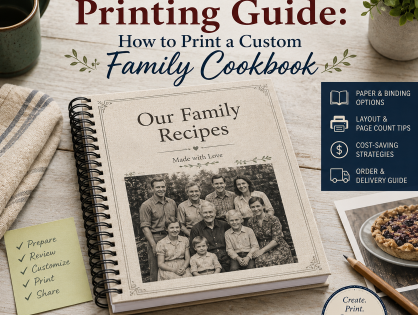
    Cookbook Printing Guide: How to Print a Custom Family Cookbook

    Printing your family cookbook is the exciting final step that turns recipes, stories, and photos into a keepsake your family can hold, cook from, and share. This cookbook printing guide explains how to prepare your book for printing, choose size and binding, understand page count and cost, proofread carefully, and decide whether to order professionally printed copies, print locally, or download a PDF for self-printing.

    Cookbook printing is the final step of turning recipes, photos, stories, and layout choices into a physical cookbook.

    Before printing, however, it is important to review the cookbook carefully. Recipe titles, ingredient lists, directions, contributor names, categories, photos, page layouts, and introductions should all be checked before placing an order.

    Printing cost is also affected by page count, layout choices, photos, recipe length, and formatting. A few smart design decisions can reduce page count without removing meaningful recipes. Family Cookbook Project includes tools and settings that help editors prepare their cookbook for printing and manage the final cost.

    Quick Answer: To print a custom family cookbook, finish entering recipes, organize categories, preview the full book, proofread recipes and photos, choose size, paper, binding, and cover options, estimate printing cost based on page count and quantity, then order printed copies or download a high-resolution PDF for local or self-printing.

    Review Every Recipe Before Printing

    Check each recipe for missing ingredients, incomplete directions, spelling mistakes, unclear measurements, and formatting problems. A good rule is to have someone else proofread the cookbook because editors often miss mistakes in their own work.

    Cookbook Printing Proof Checklist

    Before placing your final order, check:

    • Cookbook title spelling
    • Cover image quality
    • Contributor names
    • Recipe titles
    • Missing ingredients
    • Ingredients listed but not used in directions
    • Directions that mention missing ingredients
    • Oven temperatures
    • Cooking times
    • Serving sizes
    • Category order
    • Table of contents
    • Index
    • Photo placement
    • Photo quality
    • Blank pages
    • Dedication and acknowledgments
    • Page numbers
    • Shipping address
    • Quantity ordered

    Check out How To Get Your Cookbook Ready To Print,  6 Ways to Enter Your Recipes into a Family Cookbook, How to Dictate a Recipe Into Your Family Cookbook Project, and How to Create a Multi-Part Recipe for more information on this topic.

    Check Contributor Names and Recipe Stories

    Contributor names are part of what makes a family cookbook special. Make sure names are spelled consistently and that recipe notes or stories are included where appropriate. These details matter because they help preserve family memory along with the recipe itself.

    For families still collecting final contributions, link to Tips for Collecting and Organizing Recipes from Multiple Family Members. For more emotionally focused projects, link to Genealogy and Culinary Heritage: Creating a Family Cookbook for Future Generations.

    Understand What Affects Printing Cost

    The cost to print a family cookbook depends mainly on page count, quantity, size, paper, binding, photos, cover options, and shipping. Page count is one of the biggest drivers of cookbook printing cost. Longer recipes, larger fonts, extra spacing, photos, divider pages, and custom pages can all increase the total number of pages. Before printing, preview your cookbook and look for ways to keep the book attractive while avoiding unnecessary page growth.

    Cookbook printing cost is usually affected by:

    • Number of pages
    • Number of copies ordered
    • Cookbook size
    • Paper type
    • Binding type
    • Color photos
    • Cover options
    • Lamination
    • Shipping
    • Recipe length and layout choices

    Check out How Much Does Printing a Family Cookbook Cost?, which explains that final cost is determined by the number of pages when the cookbook is sent to print and that editors can get a quote in the Publishing Center.

    Also see Lowering the cost of printing your cookbook, which reinforces that page count is a major cost factor.

    Use Space-Saving Layout Options

    Editors can often reduce page count without deleting recipes. The right formatting choices can make the cookbook more efficient while still keeping it attractive and easy to read.

    Read Pro Tip: Space Saving Options To Lower Printing Cost, which explains that page count has a major impact on cost and that formatting changes can help reduce the number of printed pages.

    Also see Recipe Layout Tool Upgrade on FamilyCookbookProject.com, Side-by-Side Recipe Layout Now Available, and 5 New Typefaces Available for Recipe Layouts.

    Review Photos Before Printing

    Photos should be clear, properly placed, and meaningful. Review recipe photos, family photos, scanned recipe cards, and cover images before printing. Low-resolution images may not print as well as they appear on screen, so this is especially important for custom covers and divider pages.

    Check out Customizing Your Family Cookbook Cover and Family Cookbook Project Introduces New Cover Editing Tool. For photo placement inside the recipe pages, see Recipe Layout Tool Upgrade on FamilyCookbookProject.com.

    Why Blank Pages May Appear Before Printing

    Some blank pages are part of proper cookbook layout. For example, the table of contents and category dividers may need to begin on the right-hand page. Before removing or filling blank pages, review whether they are serving a layout purpose.

    See Removing Blank Pages From Your Family Cookbook and Why Your Cookbook Needs Blank Pages to explain the balance between reducing cost and maintaining proper book layout.

    Decide How Many Recipes to Include

    A cookbook does not have to include every recipe in the family archive. Editors should balance sentimental value, usefulness, page count, and cost.

    Read How Many Recipes Should My Cookbook Have? and How Many Recipes Does My Cookbook Need? which notes that larger cookbooks can be impressive, but printing cost is related to the number of pages, so editors need to balance recipe quantity and quality.

    Design Choices That Affect Printing

    A beautiful cookbook does not need to be crowded, but it also does not need to waste space. Preview your cookbook and choose a layout that balances readability, appearance, and printing cost.

    Design choices that may increase page count include:

    • Large fonts
    • Extra spacing
    • Long recipe introductions
    • Many photos
    • Full-page divider images
    • Custom pages
    • One recipe per page layouts
    • Long recipe directions

    Plan Around Deadlines

    If the cookbook is intended for Christmas, Mother’s Day, a reunion, wedding, or other event, build in extra time for proofreading, ordering, printing, shipping, and unexpected edits.

    If your cookbook is a holiday gift, work backward from the date you need it in hand. Leave time to finish recipes, proofread, order, print, ship, and wrap the books. For Christmas gifts, remind editors early that waiting until the last minute can create stress, especially if they want contributors to submit missing recipes. This is FamilyCookbookProject.com‘s busiest time of the year and cookbooks are printed on a first come for served basis, so first movers get their cookbooks sooner.

    Before your recipes become a printed cookbook, take time to review, proofread, and choose the best print options for your family. Family Cookbook Project makes it easy to turn your finished cookbook into printed copies everyone can enjoy.

    Ready to print your family cookbook? Start at FamilyCookbookProject.com, preview your book, check every recipe and photo, choose your printing options, and order professionally printed copies your family can enjoy for years.


    Bill Rice is Founder and Co-Publisher of the Family Cookbook Project, the leading online cookbook publisher with a website that helps families and individuals collect, preserve and share food memories by creating their own printed custom cookbooks. He is the author of The Wellfleet Oyster Cookbook and the Cape Cod Cocktail Cookbook (Available on Amazon), both created using FamilyCookbookProject.com. He is also editor of the Donovan Family Cookbook, now its third printing and is an avid genealogist tracing his family back to the 1600’s.

    Follow Family Cookbook Project on Facebook, Instagram, Twitter TikTok, YouTube and Pinterest!


    Frequently Asked Questions About Cookbook Printing

    How do I print a family cookbook?
    Finish entering recipes, preview the cookbook, proofread carefully, choose size and binding, estimate printing cost, then order printed copies or download a high-resolution PDF for local or self-printing.

    How much does it cost to print a family cookbook?
    Cookbook printing cost depends on page count, quantity, cookbook size, paper type, binding, photos, cover options, lamination, and shipping. Family Cookbook Project’s pricing page notes that most cookbooks average about two recipes per page.

    Can I print only one cookbook?
    Yes. Family Cookbook Project’s pricing page says the minimum print order is one copy.

    Can I print my cookbook somewhere else?
    Yes. Family Cookbook Project allows paid members to download a high-resolution PDF that can be taken to a local printer.

    Why does my cookbook have blank pages?
    Some blank pages are intentional so sections such as the table of contents or category dividers can start on the right-hand page.

    What is the deadline for printing cookbooks for Christmas?
    Family Cookbook Project’s usually sets November 30 as the Christmas delivery deadline and recommends allowing 2–3 weeks to receive professionally printed cookbooks during other times of the year.

  • How to Finish a Family Cookbook You Started Months—or Years—Ago

    How to Finish a Family Cookbook You Started Months—or Years—Ago

    You started a family cookbook with the best of intentions.

    Maybe you had a stack of recipe cards on the counter. Maybe you had a folder full of old family favorites. Maybe you thought, “This will be a great holiday gift!” Then life walked in, dropped its bags in the hallway, and stayed a while.

    Months passed. Maybe years.

    Now your cookbook is still sitting there, waiting for you like that half-finished puzzle on the card table. The good news? You do not have to start over. You do not even have to make it hard.

    In fact, finishing your cookbook may be much easier than it was when you first started.

    FamilyCookbookProject.com now offers tools that help you add recipes faster, organize your cookbook more easily, and get your printed cookbook across the finish line without turning the process into a second job.

    Let’s be real. You already have enough jobs.

    Quick Answer: To finish a family cookbook you started months or years ago, log back into your cookbook, review what is already complete, make a short list of missing recipes, add recipes in small batches, use the Smart Recipe Converter to turn recipe photos into editable text, ask relatives for recipe photos, preview the cookbook, and print one copy.

    Your Unfinished Family Cookbook Is Still Worth Finishing

    First, take a deep breath.

    Your cookbook project is not “too old.” Recipes do not go bad just because the project sat for a while. Unlike milk, they do not develop a smell and demand immediate removal from the house.

    The recipes you entered months or years ago are still there. The work you already did still counts. Every recipe, photo, note, and category you added moved you closer to a printed cookbook.

    So do not think of this as starting over.

    Think of it as picking up where you left off.

    And honestly, that is much better. You already did the hardest part: you began.

    Start With a Quick Cookbook Check-In

    Before you add anything new, look at what you already have.

    Log in to your Family Cookbook Project account and review your cookbook. You may find more progress than you remember.

    Check for three things:

    How many recipes are already entered?

    Which sections look strong?

    Which favorite recipes are still missing?

    You do not need to study every page like you are preparing for a final exam. Just get a feel for where the cookbook stands.

    Maybe your dessert section is packed, but your main dishes need help. That happens. Families are often very good at saving cookie recipes and oddly relaxed about dinner. Priorities, right?

    Once you know what you have, you can make a short list of what you still need.

    Short is the key word.

    Make a Short List of Missing Family Recipes

    When people restart a cookbook project, they often make the mistake of thinking they need to add everything.

    Every aunt’s recipe. Every holiday dish. Every casserole. Every sauce. Every handwritten card in the drawer.

    That is how a simple cookbook turns into a full-time research project with snacks.

    Instead, make a “Just Add These” list.

    Choose 10 to 20 recipes that would make the cookbook feel complete. Focus on the ones your family would miss most if they were left out.

    Ask yourself:

    What recipes do people ask for again and again?

    Which dishes remind us of someone special?

    What recipes would be hard to find if we lost the original card?

    Which recipes belong in the printed book before they disappear into the great kitchen drawer of mystery?

    This simple list gives you a clear path. You are not “finishing the cookbook” in some huge, vague way. You are just adding the missing recipes that matter most.

    That feels doable because it is doable.

    Use the Smart Recipe Converter to Skip the Typing Marathon

    Here is where finishing gets much easier.

    If you have handwritten recipe cards, printed recipes, screenshots, or photos of recipes, you do not have to type them all by hand.

    FamilyCookbookProject.com’s Smart Recipe Converter can help turn a photo or scan of a recipe into editable text.

    That means you can take a picture of Grandma’s handwritten recipe card, upload it, and let the tool do much of the typing work for you.

    Is that a relief? Yes. Is it magic? Pretty close. The only thing missing is a tiny wizard hat on your phone.

    This is especially helpful if you have:

    • Old recipe cards
    • Printed family recipes
    • Recipes saved as screenshots
    • Photos of cookbook pages
    • Recipes typed on paper years ago
    • Handwritten notes from relatives

    Instead of sitting down to type each recipe from scratch, you can upload the image, review the converted text, make any needed edits, and save it into your cookbook.

    You still want to check the recipe after conversion. Old handwriting can be tricky. Some of us write “teaspoon” like we are trying to hide state secrets. But even with a quick review, the Smart Recipe Converter can save a lot of time.

    And time is often the reason cookbooks stay unfinished.

    Add Recipes in Small Batches

    Do not try to finish the whole cookbook in one sitting.

    That sounds heroic, but so does cleaning the whole garage on a Saturday. We all know how that usually ends: one labeled box, three old extension cords, and regret.

    Instead, add recipes in small batches.

    Try this simple plan:

    • Upload five recipes today.
    • Review five recipes tomorrow.
    • Add personal notes to five recipes later in the week.

    Small steps work because they keep the project moving without making you feel buried.

    You can even set a timer for 20 minutes. Add or review what you can. Then stop.

    A family cookbook does not need one giant burst of energy. It needs steady little pushes.

    Ask Family Members for Recipes and Photos, Not Homework

    If you still need recipes from family members, make your request easy.

    Instead of asking people to type everything perfectly, ask them to send a photo of the recipe.

    That one change can make a big difference.

    Try this message:

    “I’m finishing our family cookbook and would love to include your favorite recipe. You can just take a photo of the recipe card or printed recipe and send it to me. I can add it from there.”

    That feels simple.

    People are much more likely to send a quick photo than sit down and type a full recipe. They can do it while standing in the kitchen. They can do it while cleaning out a drawer. They can do it while pretending they are not avoiding another task.

    Once they send the photo, you can use the Smart Recipe Converter to help add it to the cookbook.

    Less typing for them. Less typing for you. Everyone wins.

    Make the Cookbook Useful, Not Perfect

    When you come back to an older cookbook project, you may notice things you want to improve.

    A recipe title may need a tweak. A category may feel off. A direction may be missing a cook time. A note may need a little polish.

    Fix what matters.

    Then keep moving.

    Your goal is not to create the world’s most perfect cookbook. Your goal is to create a printed cookbook your family can use and enjoy.

    Will someone notice if one recipe says “Mom’s Brownies” and another says “Brownies from Mom”? Probably not.

    Will they care that the recipe is saved, printed, and ready to bake? Absolutely.

    A printed cookbook with small imperfections is still a treasure. An unfinished cookbook with perfect intentions is still unfinished.

    That may sound blunt, but it is true. And sometimes blunt is helpful. Like a spatula.

    Add a Few Notes That Make People Smile

    If you want your cookbook to feel more personal, add short recipe notes.

    You do not need a long story for every dish. A simple sentence can bring a recipe to life.

    Try notes like:

    • “Grandma made this every Easter.”
    • “This was always the first dessert gone at family parties.”
    • “Dad doubled the garlic, whether the recipe said to or not.”
    • “Best served warm, with someone else doing the dishes.”

    These little notes turn recipes into memories. They also make the cookbook more fun to read.

    Food is never just food in a family cookbook. It is people, places, stories, habits, and a few mild arguments about who really invented the potato salad.

    Preview It Like a Reader

    Once you have added the missing recipes, preview your cookbook.

    Try to look at it the way a family member will.

    Can they find recipes easily?

    Do the sections make sense?

    Does the cover title feel right?

    Do the recipes look clear enough to cook from?

    Are the most important family favorites included?

    You do not need to catch every tiny issue. Just make sure the cookbook feels ready.

    If you want help, ask one trusted person to review it. Choose someone kind and practical. Do not choose the person who once corrected the grammar on a birthday cake.

    This Is Easier Than It Used to Be

    If you started your cookbook a long time ago, you may remember typing recipes by hand.

    Now, with tools like the Smart Recipe Converter, finishing can be much faster.

    You can take old recipe cards, printed pages, and recipe photos and turn them into cookbook entries with less work. You can ask family members to send quick photos instead of typed recipes. You can add a batch at a time and build momentum.

    That old project does not have to stay old.

    It can become this year’s holiday gift. Or reunion keepsake. Or birthday surprise. Or Mother’s Day treasure. Or just the cookbook your family has been waiting for without knowing how much they wanted it.

    Give Yourself a Simple Cookbook Deadline

    A family cookbook is easier to finish when it has a purpose. Instead of saying, “I need to finish this someday,” connect the project to a real occasion. Your finished cookbook could become a Christmas gift, Mother’s Day gift, family reunion keepsake, anniversary surprise, birthday present, or memorial tribute. A clear deadline helps you decide what truly needs to be included and what can wait for a future edition.

    Bring It Back to Life

    A cookbook you started months or years ago is not a failure.

    It is a head start.

    You already cared enough to begin. You already saved recipes. You already imagined the finished book.

    Now you have easier tools to help you finish.

    So open your cookbook. Look at what you have. Make a short list of what is missing. Use the Smart Recipe Converter to add recipes faster. Ask family members for photos of their recipes. Review the book. Print one copy.

    That is how a long-paused project becomes a finished family treasure.

    And once that printed cookbook arrives, you may wonder why you waited so long.

    But do not worry. We will not tell anyone.

    We will just be over here, cheering you on — and hoping someone included the brownies.

    Bill Rice is Founder and Co-Publisher of the Family Cookbook Project, the leading online cookbook publisher with a website that helps families and individuals collect, preserve and share food memories by creating their own printed custom cookbooks. He is the author of The Wellfleet Oyster Cookbook and the Cape Cod Cocktail Cookbook (Available on Amazon), both created using FamilyCookbookProject.com. He is also editor of the Donovan Family Cookbook, now its third printing and is an avid genealogist tracing his family back to the 1600’s.

    Follow Family Cookbook Project on Facebook, Instagram, X (Twitter) TikTok, YouTube and Pinterest!
     

    Frequently Asked Questions About Finishing a Family Cookbook

    How do I finish a family cookbook I started years ago?

    Start by reviewing what is already in the cookbook, then make a short list of the most important missing recipes. Add recipes in small batches, ask relatives for recipe photos, preview the cookbook, and print one copy instead of trying to make it perfect.

    Do I have to start over if my cookbook project is old?

    No. If your recipes, notes, photos, and categories are still saved, your old cookbook project is a head start. You can update it, add missing recipes, and continue from where you left off.

    How many recipes do I need to finish a family cookbook?

    There is no required number. A smaller cookbook with 25–50 meaningful family recipes can still be valuable, while larger family cookbooks may include 100 or more recipes.

    What is the fastest way to add old recipe cards to a cookbook?

    The fastest way is to take clear photos or scans of the cards and use a recipe conversion tool to turn them into editable text. Then review the converted recipe for accuracy before saving it.

    How can I get family members to send recipes?

    Make the request simple. Ask relatives to send a photo of a recipe card, printed recipe, or handwritten note instead of asking them to type everything perfectly.

    Should I print my cookbook before it is perfect?

    Yes, if the recipes are readable and the most important family favorites are included. A printed cookbook with small imperfections is more valuable than an unfinished cookbook no one can use.

  • Pro Tip: The Need For Blank Pages In A Cookbook

    Pro Tip: The Need For Blank Pages In A Cookbook

    While removing a few extra pages might save you a few pennies when printing, almost all blank pages are needed. In the publishing world, certain pages need to start on the right side of a two page layout.  The Table of Contents and Category Dividers are two examples of these types of pages that always are placed on the right side of a two page layout.

    Quick Answer: Blank pages appear in a cookbook because printed books often need major sections, such as the Table of Contents or category dividers, to start on the right-hand page. A blank page may be added at the end of a section to keep the next section in the correct position. These pages may change as recipes are added, edited, or removed.

    If you run your preview and look at the 3D Preview, you’ll see that almost all blank pages are the end of sections to leave the new sections to start fresh.

    In terms of the recipes categories, if the last page of a recipe category is blank, that page was placed there so as to have the next category starts on the right page side. However, if you add additional recipes to that first section, the blank page may come and go depending on the number of recipes in the section.

    You have an option of adding a photo using the Cookbook Picture Manager or a custom page using the Custom Pages Tool to the “end” of any recipe section. That can help fill the blank page. However, if you have not finished the section and add/edit recipes, you may end up with a blank page after your photo/custom page, so wait until all of your recipes are added before considering adding any custom pages.

    Blank Page Troubleshooting Checklist

    • Review the cookbook in 3D Preview.
    • Check whether the blank page appears before a Table of Contents, divider, or new category.
    • Confirm that all recipes have been added.
    • Avoid filling blank pages until recipe editing is complete.
    • Decide whether the blank page improves section layout.
    • Add a photo or custom page only after the section is final.
    • Preview again before placing the print order.

    Bill Rice is Founder and Co-Publisher of the Family Cookbook Project, the leading online cookbook publisher with a website that helps families and individuals collect, preserve and share food memories by creating their own printed custom cookbooks. He is the author of The Wellfleet Oyster Cookbook and the Cape Cod Cocktail Cookbook (Available on Amazon), both created using FamilyCookbookProject.com. He is also editor of the Donovan Family Cookbook, now it’s third printing and is an avid genealogist tracing his family back to the 1600’s.

    Follow Family Cookbook Project on Facebook, Instagram, Twitter TikTok, YouTube and Pinterest!

    Frequently Asked Questions About Blank Pages in a Cookbook

    Why are there blank pages in my cookbook?
    Blank pages often appear because printed books use two-page layouts. Major sections, such as the Table of Contents or category dividers, may need to start on the right-hand page, so a blank page is added before them.

    Are blank pages in my cookbook a mistake?
    Not usually. Many blank pages are intentional and help the cookbook print with a cleaner, more professional layout.

    Can I remove blank pages from my cookbook?
    Some blank pages may change as recipes are added or edited, but others may be needed for proper section placement. Review the 3D Preview before deciding whether to fill or adjust them.

    Can I add a photo to a blank page?
    Yes. After your recipes are final, you may be able to add a photo using the Cookbook Picture Manager or add a custom page using the Custom Pages Tool.

    Why do blank pages appear at the end of recipe sections?
    A blank page may appear at the end of a recipe section so the next category or divider can begin on the right-hand page.

    When should I fill blank pages with photos or custom pages?
    Wait until all recipes have been added and edited. If you fill blank pages too early, the page layout may change and the blank page may move.

  • The Top Reasons Family Cookbook Projects Stall—and How to Get Yours Moving Again

    The Top Reasons Family Cookbook Projects Stall—and How to Get Yours Moving Again

    Every family cookbook begins with good intentions.

    You picture the finished book. You imagine everyone’s favorite recipes in one place. You think about passing it around at the holidays, giving it as a gift, or setting it on the kitchen counter where it can finally be used instead of living in three drawers, two email folders, and one mysterious shoebox.

    Then something happens.

    The project slows down.

    Then it stops.

    And suddenly your family cookbook is sitting there like a gym membership in February. Full of promise. Quietly waiting. Not judging you, exactly, but also not printing itself.

    If your cookbook project has stalled, you are not alone. It happens all the time. The good news? A stalled cookbook is not a failed cookbook. It is simply a project that needs a small push.

    Let’s look at why cookbook projects stall and, more importantly, how to get yours moving again.

    Quick Answer: Family cookbook projects usually stall because editors are waiting for more recipes, the project feels too large, typing recipes takes too long, photos are missing, or the editor is afraid of making mistakes. To restart, set a final recipe deadline, work in small batches, use recipe photos or the Smart Recipe Converter, choose a theme for this edition, and preview the cookbook.

    Reason 1: You Were Waiting for “Just a Few More Recipes”

    This may be the most common reason family cookbooks get stuck.

    You have a good collection of recipes already, but you keep thinking, “I should wait until I get a few more.”

    A few more from your sister. A few more from the cousins. A few more from Uncle Bob, who promised to send his barbecue sauce recipe in 2021 and has since entered witness protection, apparently.

    Waiting for more recipes sounds reasonable. But it can keep your cookbook unfinished for months or years.

    Here is the fix: set a final recipe deadline.

    Send one friendly reminder to the people you still want to hear from. Give them a clear date. Then move forward.

    You can say:

    “I’m finishing the family cookbook and placing the first print order soon. Please send any final recipes by Friday if you want them included in this edition.”

    Notice the magic words: this edition.

    That takes the pressure off. You are not saying this is the only cookbook your family will ever make. You are saying this version is ready to finish.

    And if someone sends a recipe later? Great. Add it to the next edition.

    Reason 2: The Project Feels Too Big

    A family cookbook can start to feel huge.

    There are recipes to add. Photos to find. Notes to write. Categories to organize. Names to check. Covers to choose. Suddenly, what started as a sweet family project feels like you accidentally volunteered to run a small country.

    No wonder people stop.

    Here is the fix: shrink the next step.

    Do not think, “I need to finish the cookbook.”

    Think:

    “I need to review five recipes.”

    Or:

    “I need to add three missing recipes.”

    Or:

    “I need to choose a cover.”

    Small steps work because they feel possible. And once you complete one, the next one feels easier.

    Try working in short sessions. Set a timer for 20 minutes. Review or add what you can. Then stop.

    That may sound too simple, but small bits of steady work can bring a cookbook back to life fast.

    After all, most family recipes were not built in one giant leap either. They were built one spoonful, one pinch, and one “just add a little more” at a time.

    Reason 3: Typing Recipes Took Too Long

    Typing recipes can slow everything down.

    If you have old recipe cards, printed pages, or handwritten notes, the idea of typing them all by hand may make you want to lie down quietly and rethink your hobbies.

    But here is the good news: you do not have to do all that typing anymore.

    FamilyCookbookProject.com’s Smart Recipe Converter makes it much easier to add recipes. You can upload a photo, scan, or screenshot of a recipe and turn it into editable text. This is especially helpful for stalled cookbook projects because old recipe cards, screenshots, and family recipe photos no longer have to sit in a folder waiting for someone to type them by hand.

    That means you can take a picture of an old recipe card, upload it, review the converted recipe, make a few edits, and save it to your cookbook.

    This tool can help with:

    • Handwritten recipe cards
    • Printed recipes
    • Screenshots
    • Typed recipe pages
    • Recipes sent by family members as photos
    • Old family recipe collections

    You still need to review the recipe after conversion. Handwriting can be tricky, especially when someone wrote “1 tsp” like they were signing a doctor’s note. But the Smart Recipe Converter can save a lot of time and make finishing feel much easier.

    Even better, you can ask family members to send photos of recipes instead of typing them.

    That one change can make a big difference.

    Try this:

    “Please send a photo of your recipe card or printed recipe. I can add it to the cookbook from there.”

    Simple. Easy. Much less likely to be ignored.

    Reason 4: You Could Not Decide What to Include

    Some cookbook projects stall because the editor gets stuck making decisions.

    Should you include every recipe? Only family favorites? Should the store-bought cake mix recipe count? What about the one recipe nobody makes anymore but everyone remembers?

    Decisions can pile up like dishes after Thanksgiving dinner.

    Here is the fix: choose a theme for this edition.

    Your cookbook does not have to be everything. It can be one clear thing.

    For example:

    • “Our Family Favorites”
    • “Grandma’s Recipes”
    • “Holiday Traditions”
    • “Best Recipes from the Cousins”
    • “Recipes for the Next Generation”
    • “Comfort Foods We Love”

    A theme gives you a filter. If a recipe fits the theme, include it. If it does not, save it for later.

    And yes, the cake mix recipe can count if your family loves it. Family cookbooks are not cooking contests. No one is standing there with a tiny scorecard saying, “Technically, this begins with a boxed mix.”

    If the recipe matters to your family, it belongs.

    Reason 5: You Were Waiting for Better Photos

    Photos add warmth to a family cookbook. They make the book feel personal. They help people remember the cook, the kitchen, the holiday, the table, and maybe the wallpaper nobody wants to discuss.

    But photos can also become a roadblock.

    You may think you need a photo for every recipe. Or you may want better scans of old pictures. Or you may keep waiting for someone to send that one perfect family photo.

    Here is the fix: use what you have.

    A cookbook does not need a photo on every page to be meaningful.

    Use a few strong photos where they matter most. Add a picture of Grandma, a holiday table, a handwritten recipe card, a family reunion, or a finished dish. Even one or two photos in each section can add a lot of heart.

    And remember: old photos do not need to look perfect. A slightly faded kitchen photo can carry more feeling than a perfect food photo from the internet.

    Real beats perfect. Especially in a family cookbook.

    Reason 6: You Were Afraid of Making a Mistake

    This one sneaks up on people.

    You may worry about typos. Missing ingredients. Wrong names. A recipe that does not look quite right. A family member who may point out that the famous “Aunt Joan’s Brownies” actually came from Aunt Jean.

    These worries can stop the whole project.

    Here is the fix: print one copy first.

    You do not have to order copies for the whole family right away. Print one copy and review it in your hands.

    A printed copy helps you see the cookbook in a new way. You can flip through it, mark any small changes, and decide what to adjust before ordering more.

    This makes the final step feel safer.

    And honestly, even if a tiny mistake slips through, your family will still love the book. They are not looking for a flawless publishing masterpiece. They are looking for the recipes they remember.

    They want the cookies. The soup. The Sunday sauce. The pie.

    They are not going to reject the cookbook because a comma wandered off.

    Reason 7: You Forgot How Much It Matters

    Sometimes a cookbook project stalls because the emotional fuel runs low.

    You start strong, then the project becomes a task. The meaning gets buried under details.

    So pause and remember why you started.

    You wanted to save recipes that matter. You wanted to honor the people who made them. You wanted to help the next generation cook the foods that taste like family.

    That is a wonderful reason to finish.

    A printed cookbook is more than a stack of recipes. It is a gift. It is a family record. It is a way to say, “These meals mattered. These people mattered. These memories are worth keeping.”

    When someone opens the cookbook and sees a recipe in a loved one’s name, it means something.

    When a child or grandchild makes that recipe years from now, it means even more.

    That is worth finishing.

    What Counts as a Finished Family Cookbook?

    A family cookbook can be finished when it has:

    • A meaningful title
    • The most important family recipes
    • Clear recipe categories
    • Recipes that are readable and complete
    • A cover you like
    • A few family photos or recipe stories
    • A final preview

    A Simple Restart Plan

    Here is an easy way to get your cookbook moving again.

    First, log in and review what you already have. Do not edit yet. Just look.

    Next, make a short list of what is missing. Keep it to the recipes that matter most.

    Then use the Smart Recipe Converter to add recipe cards, printed pages, screenshots, or photos without typing everything from scratch.

    After that, organize your categories and add a few personal notes if you want.

    Finally, preview the cookbook and print one copy.

    That is it.

    No giant plan. No family committee. No waiting until every recipe in the known universe has been collected.

    Just one step, then the next.

    Your Stalled Cookbook Is Still Worth Finishing

    A stalled family cookbook is not a sign that you failed. It is a sign that life got busy.

    That happens. Life is very good at being life.

    But the recipes are still there. The memories still matter. The people you wanted to honor are still worth honoring.

    And with tools like the Smart Recipe Converter, adding the last few recipes can be much easier than it used to be.

    So open the project again. Take a look. Add a recipe. Review a section. Pick a print date.

    Your cookbook does not need another year of waiting.

    It needs one small step.

    Then another.

    Before you know it, you will hold the finished cookbook in your hands and wonder why it felt so hard to get started again.

    And when that happens, go ahead and smile.

    Maybe even celebrate with one of the recipes inside.

    Family Cookbook Restart Checklist

    • Log in and review what you already have.
    • Count the recipes already entered.
    • Make a short list of the most important missing recipes.
    • Send one final recipe reminder with a deadline.
    • Ask relatives to send recipe photos instead of typed recipes.
    • Use the Smart Recipe Converter for recipe cards, screenshots, and printed recipes.
    • Choose a theme for this edition.
    • Add a few meaningful photos, not one for every recipe.
    • Preview the cookbook.

    Ready to get your family cookbook moving again? Log in to FamilyCookbookProject.com, review what you already have, add one missing recipe, use the Smart Recipe Converter for recipe cards or photos, and take the next small step toward printing your finished cookbook.

    Bill Rice is Founder and Co-Publisher of the Family Cookbook Project, the leading online cookbook publisher with a website that helps families and individuals collect, preserve and share food memories by creating their own printed custom cookbooks. He is the author of The Wellfleet Oyster Cookbook and the Cape Cod Cocktail Cookbook (Available on Amazon), both created using FamilyCookbookProject.com. He is also editor of the Donovan Family Cookbook, now its third printing and is an avid genealogist tracing his family back to the 1600’s.

    Follow Family Cookbook Project on Facebook, Instagram, X (Twitter) TikTok, YouTube and Pinterest!
     

    Frequently Asked Questions About Stalled Family Cookbook Projects

    Why do family cookbook projects stall?
    Family cookbook projects often stall because editors are waiting for more recipes, the project feels too big, typing recipes takes too long, photos are missing, or the editor is worried about making mistakes before printing.

    How do I restart an unfinished family cookbook?
    Start by reviewing what you already have. Then make a short list of missing recipes, set a final recipe deadline, add recipes in small batches, preview the cookbook, and print one copy.

    What if family members have not sent their recipes?
    Send one final reminder with a clear deadline. Ask relatives to send a photo of a recipe card or printed recipe instead of asking them to type everything.

    Do I need every family recipe before printing?
    No. A family cookbook can be printed as “this edition.” Late recipes can always be added to a future edition.

    What is the fastest way to add old recipe cards?
    Take clear photos or scans of the recipe cards and use the Smart Recipe Converter to turn them into editable text. Always review the converted recipe before saving it.

  • Pro Tip: Understanding Your Editor Account Options

    Pro Tip: Understanding Your Editor Account Options

    If you are new to Family Cookbook Project, your editor account is the control center for creating, organizing, designing, previewing, and publishing your cookbook. From your editor homepage, you can add recipes, invite contributors, change cookbook settings, choose layouts, preview your book, and manage account details. This guide explains the main homepage options and navigation links so you know where to go next.

    Quick Answer: Your Family Cookbook Project editor account is where you manage your cookbook. The Quick Start homepage gives shortcuts to common sections such as Recipes, Layout and Design, Contributors, Cookbook Info, and Publishing. The Full Page homepage shows more cookbook details, including contributor information, a recipe table of contents, newest recipes, and contributor welcome content.

    Editor’s Homepage

    For most people, your homepage is set to the “Quick Start” version which features a section for Alerts and Notices, Recipes, Layout and Design, Cookbook and Account Info, Contributors, Our Blog, and Cookbook Publishing.

    Each section has a number of “quick links” on the homepage to highly used pages, but more importantly, a green button that will take you to the full set of links for that section.

    The other option for homepage is the “Full Page”. This was our original homepage and shows your contributor welcome message and photo, a table of contents of recipes, a list of contributors, and a list of newest recipes.

    In the upper right corner of your editor’s homepage is a drop down menu to select either of these pages.

    Along the top of both Editor home page’s is a black navigation bar that contains important links that will follow you on all pages of the site:

    • Cookbook Home – Takes you back to your homepage.
    • Editor Activities – Links to take you directly to a section without having to go to the homepage.
    • Add Recipe – Here is where you add your own recipes.
    • View Recipes – Several choices to see the recipes in your cookbook
    • Edit Your Info – Here is where you can change your email and password. (usernames can not be changed once the account is set up).
    • Preview Book – Here you can create a PDF proof of your cookbook to view online or download.
    • Logout – This logs you out of your account.

    Editor Account vs. Contributor Account

    A cookbook editor manages the overall cookbook, including recipe categories, layout, contributors, previewing, and publishing. Contributors add only recipes, and photos to the cookbook but do not manage the full cookbook setup. If you are organizing the cookbook for your family or group, you will spend most of your time in the editor account.

    Your editor account is the control center for your cookbook. Use the homepage shortcuts and black navigation bar to add recipes, manage contributors, update account details, preview your book, and move your cookbook closer to printing.

    Bill Rice is Founder and Co-Publisher of the Family Cookbook Project, the leading online cookbook publisher with a website that helps families and individuals collect, preserve and share food memories by creating their own printed custom cookbooks. He is the author of The Wellfleet Oyster Cookbook and the Cape Cod Cocktail Cookbook (Available on Amazon), both created using FamilyCookbookProject.com. He is also editor of the Donovan Family Cookbook, now it’s third printing and is an avid genealogist tracing his family back to the 1600’s.

    Follow Family Cookbook Project on Facebook, Instagram, Twitter TikTok, YouTube and Pinterest!

    Frequently Asked Questions About Your Editor Account

    What is a Family Cookbook Project editor account?
    A Family Cookbook Project editor account is the main account used to manage a cookbook. Editors can add recipes, organize categories, invite contributors, adjust layout and design, preview the cookbook, and prepare it for printing.

    What is the Quick Start homepage?
    The Quick Start homepage is the default editor homepage for most users. It provides shortcuts to common cookbook sections such as Recipes, Layout and Design, Cookbook and Account Info, Contributors, Blog, and Cookbook Publishing.

    What is the Full Page homepage?
    The Full Page homepage is an alternate view that shows more cookbook information, including the contributor welcome message and photo, a table of contents of recipes, a contributor list, and newest recipes.

    How do I switch homepage views?
    You can switch between Quick Start and Full Page from the dropdown menu in the upper-right corner of your editor homepage.

    Where do I add recipes?
    Use the Add Recipe link in the black navigation bar to enter recipes into your cookbook.

    Where do I preview my cookbook?
    Use the Preview Book link in the black navigation bar to create a PDF proof that you can view online or download.

    Can I change my username?
    No. The article explains that usernames cannot be changed once the account is set up, although users can update their email and password under Edit Your Info.

  • Checklist for Creating Your Family Cookbook: A Step-by-Step Guide to Preserving Family Recipes

    Checklist for Creating Your Family Cookbook: A Step-by-Step Guide to Preserving Family Recipes

    Creating a family cookbook is a beautiful way to preserve your family’s culinary traditions and share them with future generations. It’s more than just a collection of recipes—it’s a way to capture the stories, memories, and flavors that have shaped your family gatherings over the years. Whether you’re making a family cookbook as a gift, a keepsake, or simply to organize your recipes, the process can be both rewarding and fun.

    To help you get started, we’ve put together a checklist that will guide you through the entire process, from gathering recipes to designing and publishing your custom cookbook. By following this step-by-step guide, you can ensure that your family cookbook will be a treasure for years to come.

    1. Start by Gathering Recipes

    The first step in creating your family cookbook is to gather all the recipes you want to include. These might be family favorites passed down through generations, new dishes that have become staples, or personal creations that you want to share. Don’t worry if you don’t have every recipe in perfect form just yet—you can gather them over time as you work on your cookbook.

    • Tip: Ask family members to contribute their favorite recipes. You can send out a family-wide email, set up a shared online folder, or even have a recipe-sharing gathering. This ensures that everyone gets to participate, and you’ll have a variety of dishes from different family members.

    2. Organize the Recipes by Category

    Once you have all the recipes, the next step is to organize them into categories. This makes it easier to navigate the cookbook and ensures that it has a logical flow. Common categories include:

    • Appetizers
    • Main Dishes
    • Side Dishes
    • Desserts
    • Breakfast/Brunch
    • Drinks
    • Holiday or Special Occasion Recipes
    • Tip: You can also get creative with your categories. For example, if your family has strong holiday traditions, you might create sections like “Holiday Favorites” or “Summer BBQ Recipes.”

    3. Test and Edit the Recipes

    Before you finalize the recipes for your cookbook, it’s important to ensure they’re accurate and easy to follow. Test each recipe to confirm that the measurements, cooking times, and instructions are correct. This is especially important for older family recipes that may have been passed down verbally or written down without precise instructions.

    • Tip: While testing, take note of any variations or tips that might be helpful for someone trying the recipe for the first time. You can add these tips as side notes or footnotes in the cookbook.

    4. Collect Family Stories and Photos

    A family cookbook isn’t just about the recipes—it’s about the memories and stories that go along with them. Ask family members to share stories behind their recipes, such as why it’s a family favorite or a special memory associated with it. Adding these personal touches will make your cookbook more meaningful and enjoyable to read.

    • Tip: Include photos of the family members who contributed the recipes, as well as pictures of family gatherings where these dishes were served. You can even add photos of the dishes themselves to make the cookbook visually appealing.

    5. Choose a Title for Your Cookbook

    Your family cookbook’s title sets the tone for the entire project. Choose a title that reflects your family’s personality, traditions, or a theme that runs through your recipes. Some families opt for simple, classic titles like “The [Family Name] Cookbook,” while others get creative with names that highlight their culinary heritage.

    • Tip: You can also include the year or volume number in the title if you plan to create more editions in the future (e.g., “The Donovan Family Cookbook 2024” or “The Anderson Family Cookbook, Volume 1”).

    6. Select the Cookbook Format and Binding

    When it comes to printing your cookbook, FamilyCookbookProject.com offers several size and binding options. You’ll want to choose a format that fits your vision for the project and the practicality of using the cookbook in the kitchen.

    • Popular Sizes:
    • Standard Size (5 1/2” x 8 1/2”): A compact and budget-friendly option that’s easy to handle in the kitchen.
    • Full Size (8 1/2” x 11”): Offers more space for larger text, photos, and longer recipes.
    • Square Size (8 1/2” x 8 1/2”): A stylish and modern option that’s great for photo-heavy cookbooks.
    • Binding Options:
    • Spiral Bound: The most popular option for cookbooks because it allows the pages to lay flat while cooking.
    • Hardcover: Adds elegance and durability to your cookbook, making it a beautiful keepsake.
    • Perfect Bound Paperback: A polished option that includes the title on the spine, perfect for displaying on bookshelves.

    7. Design the Layout and Cover

    The design of your family cookbook is an important aspect of its overall appeal. Think about how you want the cookbook to look and feel. Consider elements like font style, color schemes, and whether you want to include photos with each recipe.

    • Tip: Choose a cover that represents your family or the theme of the cookbook. You can use a family photo, a picture of a beloved dish, or even custom artwork. Don’t forget to update the cover if you’re creating multiple volumes!

    8. Proofread and Finalize the Cookbook

    Before sending your cookbook to print, make sure you carefully proofread all the recipes, stories, and captions. This step ensures there are no typos or missing ingredients. It’s a good idea to have someone else read through the cookbook as well, as they might catch errors you’ve missed.

    • Tip: Check not only for spelling and grammar but also for consistency in formatting (e.g., making sure all measurements are written the same way) and accuracy in cooking instructions.

    9. Print and Distribute

    Once everything is finalized, it’s time to print your family cookbook! FamilyCookbookProject.com makes it easy to order professionally printed copies, whether you need just a few or want to print in bulk.

    • Tip: If you’re creating the cookbook as a gift or for a special occasion, plan ahead to ensure the books are printed and delivered in time. Consider creating a digital version of the cookbook as well, so family members can access it on their devices.

    10. Celebrate and Share

    After all your hard work, it’s time to celebrate! Host a family gathering to unveil the cookbook and share some of the recipes. This can be a wonderful opportunity to cook a few of the featured dishes together and reminisce about the memories that went into creating the cookbook.

    • Tip: Encourage family members to keep contributing recipes for future editions of the cookbook. You can make this a yearly tradition by updating the cookbook or creating new volumes.

    Creating a family cookbook is a rewarding project that not only preserves your family’s culinary traditions but also brings everyone closer together. By following this checklist, you’ll be able to create a cookbook that is both practical and meaningful—one that future generations will cherish. Ready to start your own family cookbook? Visit FamilyCookbookProject.com to get started today!

    Bill Rice is Founder and Co-Publisher of the Family Cookbook Project, the leading online cookbook publisher with a website that helps families and individuals collect, preserve and share food memories by creating their own printed custom cookbooks. He is the author of The Wellfleet Oyster Cookbook and the Cape Cod Cocktail Cookbook (Available on Amazon), both created using FamilyCookbookProject.com. He is also editor of the Donovan Family Cookbook, now it’s third printing and is an avid genealogist tracing his family back to the 1600’s.

    Follow Family Cookbook Project on Facebook, Instagram, Twitter TikTok, YouTube and Pinterest!