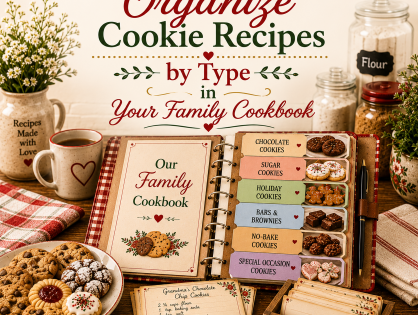
A great cookie recipe deserves to be easy to find. When you’re flipping through your family cookbook, searching for Grandma’s gingerbread or your aunt’s chocolate chip masterpiece, the last thing you want is to dig through pages of unrelated recipes. That’s where good organization comes in.
The way you organize your cookie recipes can turn your cookbook from a cluttered list into a smooth, enjoyable baking experience — one that reflects your family’s traditions and makes it easy for future generations to follow in your footsteps.
Here’s how to categorize, label, and organize your cookie recipes by type using Family Cookbook Project, so your collection feels as sweet and polished as the cookies themselves.
-
Why Organization Matters in a Family Cookbook
A well-organized cookbook doesn’t just look good — it makes baking simpler and more enjoyable.
When recipes are grouped logically, you can:
- Find what you need quickly.
- Discover forgotten favorites more easily.
- See at a glance what types of cookies you already have (and where you might want to add more).
A clear structure also makes your cookbook more useful for others in the family — especially younger bakers who may not yet know every recipe by heart.
Family Cookbook Project allows you to create custom categories, so you can sort your cookies in whatever way makes sense for your family.
-
Start with Broad Cookie Categories
 The first step in organizing your cookie recipes is to divide them into clear, broad categories. These categories make the cookbook intuitive to use and easy to browse.
Here are a few classic options that work well for most families:
- Drop Cookies – Cookies made by dropping spoonfuls of dough onto a baking sheet. Examples: chocolate chip, oatmeal raisin, or peanut butter.
- Rolled Cookies – Cookies made from dough rolled out and cut into shapes. Think sugar cookies, gingerbread men, or shortbread.
- Bar Cookies – Baked in a pan and cut into squares or bars. Examples include brownies, blondies, and lemon bars.
- Refrigerator or Slice-and-Bake Cookies – Dough rolled into logs, chilled, and sliced before baking. Great for pinwheels or butter cookies.
- Pressed or Spritz Cookies – Shaped with a cookie press or piping bag, often delicate and buttery.
- No-Bake Cookies – Quick treats made without using the oven. Perfect for kids to make.
- Sandwich Cookies – Cookies with filling, such as whoopie pies or linzer cookies.
- Specialty Cookies – Include anything unique to your family — like gluten-free, vegan, or heritage cookies passed down through generations.
By starting with these foundational categories, you make the book intuitive for everyone — even someone new to baking.
-
Add Subcategories for a Personal Touch
Once you’ve built your broad categories, take it a step further by adding subcategories that reflect your family’s traditions or tastes.
For example:
- Under Holiday Cookies, you might include “Christmas Classics,” “Hanukkah Favorites,” or “New Year’s Treats.”
- Within Chocolate Cookies, you could list “Brownie-Inspired,” “Double Chocolate,” or “Chocolate Chip Variations.”
- Under Family Favorites, include cookies tied to a specific person — “Grandma’s Collection,” “Mom’s Best Bakes,” or “The Kids’ Creations.”
Family Cookbook Project gives you flexibility to name and arrange your categories however you like — so your book can feel uniquely yours.
-
Use Consistent Formatting for Each Recipe
Good organization goes beyond categories — it also means keeping each recipe easy to read and consistent in format.
A clean, predictable layout helps bakers focus on what matters: the cookies.
When adding recipes, be sure to include:
- A clear title (with descriptive keywords, like “Chewy Oatmeal Raisin Cookies”).
- An ingredient list in the order they’re used.
- Step-by-step directions.
- Bake time, temperature, and yield.
- Notes for tips, variations, or substitutions.
Family Cookbook Project standardizes this automatically when you enter your recipes, so each one appears uniform across the book.
-
Include an Index for Quick Searching
An index may seem like a small detail, but it’s a powerful tool for navigating your cookbook.
The built-in index feature in Family Cookbook Project automatically lists recipes by title and contributor, so you can quickly find any cookie by name or see who submitted it.
This feature is especially helpful in a cookie cookbook where multiple family members contribute — you can easily find “Aunt Jean’s Coconut Macaroons” or “Dad’s Peanut Butter Blossoms” without flipping through every page.
You can even include a thematic index, such as:
- “Cookies with Nuts”
- “Cookies for Gifting”
- “Cookies for Kids to Make”
Indexes make your cookbook feel more professional and easier to use.
-
Create Visual Dividers for Each Cookie Type
A family cookie cookbook should be both functional and beautiful.
Add section dividers or full-page images that introduce each type of cookie. For example:
- A festive photo of sugar cookies for the Rolled Cookies section.
- A warm tray of brownies for the Bar Cookies section.
- A whimsical image of cookie cutters for the Holiday Cookies section.
Family Cookbook Project allows you to add photos anywhere in your layout, giving each section its own personality.
If your family has a favorite baking photo — Grandma rolling dough or kids decorating cookies — those images can become the heart of the section dividers.
-
Keep Heritage Recipes Front and Center
Every family has those irreplaceable cookie recipes that have been passed down through generations. Give them their own section or highlight them with a special note, such as:
“This recipe has been part of our family since 1948.”
“Always use real butter — Grandma’s rule.”
Adding a “Family Heritage Cookies” section gives your cookbook emotional weight, connecting bakers across generations.
You might even include short family stories or handwritten recipe cards for authenticity.
-
Don’t Forget the Modern Touches
Family cookbooks grow with each generation. Include newer recipes, too — vegan cookies, air-fryer desserts, or gluten-free classics — so the book stays relevant and inclusive.
Consider adding a “New Traditions” section, where kids and younger bakers can include their own favorites. Over time, this section will show how your family’s cookie traditions evolve.
-
Keep It Manageable and Easy to Update
It’s tempting to include every cookie recipe you’ve ever made, but a focused collection is easier to use and more enjoyable to read.
Start with 30–50 of your family’s best recipes, organized clearly into categories. You can always add more later — Family Cookbook Project makes it simple to edit or expand your cookbook whenever new favorites emerge.
That flexibility ensures your cookbook grows right alongside your family traditions.
-
Make It a Legacy Piece
When you organize cookie recipes by type — and by story — you’re doing more than creating a cookbook. You’re creating a piece of family history that can be passed from one kitchen to another.
Each section, each page, each note reflects not just what your family bakes, but who your family is.
Whether it’s Grandma’s perfectly pressed spritz cookies or your child’s first chocolate chip experiment, your organized cookbook keeps them all connected — easy to find, easy to bake, and impossible to forget.
Get Started Today
Ready to bring order (and sweetness) to your recipe collection? Start organizing your cookie recipes by type with FamilyCookbookProject.com.
Create sections, upload photos, and print a beautiful cookbook that keeps your family’s baking traditions alive — and easy to find.
Because great cookies deserve to be remembered and shared, one category at a time.
Bill Rice is Founder and Co-Publisher of the Family Cookbook Project, the leading online cookbook publisher with a website that helps families and individuals collect, preserve and share food memories by creating their own printed custom cookbooks. He is the author of The Wellfleet Oyster Cookbook and the Cape Cod Cocktail Cookbook (Available on Amazon), both created using FamilyCookbookProject.com. He is also editor of the Donovan Family Cookbook, now it’s third printing and is an avid genealogist tracing his family back to the 1600’s.
Follow Family Cookbook Project on Facebook, Instagram, Twitter TikTok, YouTube and Pinterest!