
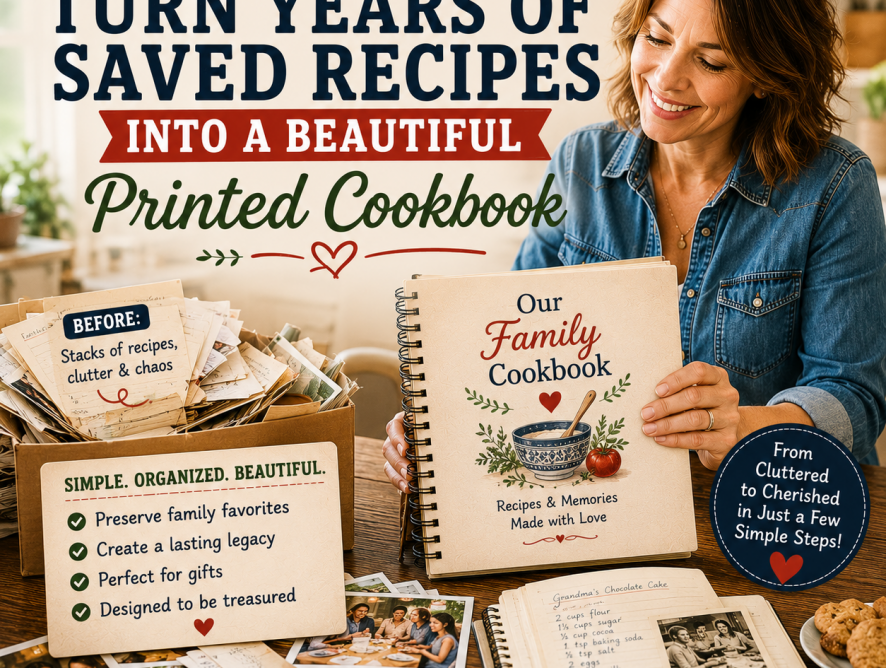
If you have years of saved recipes tucked into drawers, recipe boxes, email folders, phone photos, screenshots, browser bookmarks, and old notebooks, you are not alone. The easiest way to turn that recipe clutter into something useful is to collect everything in one place, convert what you can into editable text, organize the recipes into categories, add photos and stories, and print them in a custom cookbook.
For many families, favorite recipes are everywhere except where they need to be. One recipe lives on a stained card. Another is in a text from your sister. One is printed from a website. Another is written in handwriting that looks like it was done during a minor earthquake. And the recipe everyone wants most? Naturally, nobody knows where it is.
That is how recipes get lost. But it does not have to stay that way.
With FamilyCookbookProject.com, you can turn years of saved recipes into a beautiful printed cookbook your family can hold, use, and share. And the process is easier than most people think.
You do not need to be a designer. You do not need to be a computer expert. You do not need to spend your weekends typing recipes until your fingers file a complaint.
You just need a simple plan.
Let’s walk through it together.
Quick Answer: The easiest way to turn saved recipes into a printed cookbook is to gather recipes from cards, clippings, screenshots, emails, photos, and digital files; use Smart Recipe Converter to help turn recipe images into editable text; organize recipes into categories; add stories and photos; preview the book; proofread carefully; and order printed copies.
Start by Gathering, Not Sorting
When you decide to make a printed cookbook, it is tempting to organize everything first.
You may think, “I’ll sort all the cards, rewrite all the recipes, label all the photos, and then I’ll start.”
That sounds responsible. It also sounds like the beginning of a project that never ends.
Instead, start by gathering.
Put the recipes in one place first. Do not worry about perfect order yet. Just collect what you have.
Look for recipes in:
- Kitchen drawers
- Recipe boxes
- Old binders
- Cookbook margins
- Email folders
- Text messages
- Phone photos
- Computer files
- Printed pages
- Holiday folders
- Family reunion booklets
- Notes from parents or grandparents
Ask family members to send what they have too. But keep the request simple. Say, “Please send a photo of any favorite family recipe you want included.”
That is much easier than asking them to type the whole thing. Nobody wants a homework assignment with a side of guilt.
Once you gather the recipes, you can see what you are working with. The pile may look messy at first, but that is okay. Most good family projects begin with a little chaos. So do most holiday dinners.
Choose the Kind of Cookbook You Want to Make
Before you add every recipe you find, decide what kind of cookbook you want.
This step saves time because it gives your project a clear shape.
- Do you want a full family cookbook with everyone’s favorites?
- A cookbook based on one person, like Grandma’s recipes?
- A holiday cookbook?
- A baking cookbook?
- A reunion cookbook?
- A “recipes for the next generation” cookbook?
- A personal cookbook of your own best dishes?
There is no wrong answer.
A clear theme helps you decide what belongs in this edition. That last phrase matters: this edition.
You do not need to include every recipe your family has ever made. You can create one printed cookbook now and update it later. In fact, many families like the idea of making a first edition and adding more over time.
So give yourself permission to start with a cookbook that has a clear purpose.
If the goal is “Grandma’s Best Recipes,” you do not need to include your cousin’s new air fryer nachos. Delicious? Probably. On theme? Maybe not.
Save them for the sequel.
 Create a “Print-Worthy” Pile
Now that you have gathered your recipes and chosen a direction, make a “print-worthy” pile.
These are the recipes that deserve a place in the book.
They might be:
- Family favorites
- Holiday traditions
- Recipes tied to loved ones
- Dishes people request often
- Recipes that might get lost
- Recipes with handwritten notes
- Meals connected to a special memory
- Comfort foods your family loves
Do not judge recipes by how fancy they are.
Some of the most loved family recipes are simple. A five-ingredient casserole can mean more than a complicated dish with ingredients no one can pronounce. Let’s be real, if a recipe has been requested at every family gathering for 30 years, it has earned its place.
Your cookbook should reflect your family, not a cooking show.
If your family loves the gelatin salad, include the gelatin salad. History must be told.
Use the Smart Recipe Converter to Make Adding Recipes Easier
Here is where the process gets much easier.
FamilyCookbookProject.com’s Smart Recipe Converter helps you add recipes without typing everything from scratch.
You can upload a photo, scan, or screenshot of a recipe, and the tool helps turn it into editable text for your cookbook.
That means you can use:
- Handwritten recipe cards
- Printed recipes
- Old typed pages
- Recipe photos from relatives
- Screenshots saved on your phone
- Scanned family recipe collections
Instead of retyping every ingredient and direction, you can upload the image, review the converted text, make small fixes, and save the recipe.
That is a big help when you have years of saved recipes.
It also makes it easier to involve family members. Instead of saying, “Please type your recipe and send it to me,” you can say, “Just take a picture of the recipe and send it.”
That one change can save everyone time.
Of course, you should still review each recipe after it is converted. Old handwriting can be tricky. Some recipe cards look like they survived a pie crust emergency. But even with a quick check, the Smart Recipe Converter can take much of the heavy lifting out of recipe entry.
And that matters.
Because the easier it is to add recipes, the more likely you are to finish and print the cookbook.
Clean Up Recipes Without Rewriting Their Personality
Once recipes are added, give them a light cleanup.
Light is the key word.
You do not need to rewrite every recipe so it sounds the same. In fact, you may not want to. Part of the charm of a family cookbook is that recipes come from real people.
One recipe may say “mix well.” Another may say “stir until it looks right.” Another may include a note like “use the blue bowl.” Is that official cooking language? No. Is it wonderful? Absolutely.
When you review recipes, focus on clarity.
Check for:
- A clear title
- A complete ingredient list
- Basic directions
- Oven temperature, if needed
- Cooking or baking time, if known
- The name of the person who submitted or inspired the recipe
- If something is missing, add a note.
For example:
“Original recipe did not include a baking time. Start checking after 30 minutes.”
That helps the next cook without removing the family flavor.
Think of it as tidying the recipe, not sending it to finishing school.
Add the Stories That Make the Cookbook Special
A printed cookbook becomes more than a recipe collection when you add personal notes.
These notes do not need to be long. One or two sentences can do a lot.
For example:
“Grandma made this every Christmas morning.”
“This was Uncle Ray’s favorite dessert.”
“Mom always brought this to church suppers.”
“We served this at every summer cookout.”
“This recipe card still has flour on it from Nana’s kitchen.”
Those little details make people stop and smile.
They also help younger family members understand why the recipe matters. A child or grandchild may not remember the person who made the dish, but a short note gives them a connection.
That is one of the best parts of a family cookbook. It saves more than ingredients. It saves the “why.”
Why this recipe mattered. Why it was served. Why people loved it. Why it still belongs at the table.
Let Photos Do Some of the Storytelling
Photos can make your cookbook feel warm and personal.
You can include photos of finished dishes, but you do not have to stop there.
Family photos often mean even more.
Consider adding:
- A photo of the person known for the recipe
- A holiday table
- A family reunion
- An old kitchen photo
- A picture of a handwritten recipe card
- A wedding, birthday, or picnic photo
- A snapshot of kids helping in the kitchen
Do you need a photo for every recipe? No.
Please do not let that idea slow you down.
A few meaningful photos can make the whole cookbook feel special. Even if the pictures are old, faded, or a little blurry, they may still carry a lot of heart.
A perfect food photo shows what a dish looks like. A family photo shows why it matters.
That is the difference.
Pick a Design That Does the Hard Work for You
One reason people put off printing a cookbook is that they think they need to design it themselves.
Good news: you do not.
FamilyCookbookProject.com helps you turn your recipes into a polished cookbook with professionally designed covers and layouts. You can choose the look that fits your family and let the system handle much of the formatting.
That means your job is not to become a graphic designer overnight.
Your job is to choose what feels right.
Do you want something classic?
Warm and homey?
Bright and modern?
Holiday themed?
Centered on a family photo?
Once you choose a design, your recipes can become a real cookbook with a table of contents, recipe categories, and a clean layout.
That is a big part of what makes the process easier. You bring the recipes. The system helps shape them into a book.
It is like having a helpful kitchen assistant who never eats the last cookie.
Think of Printing as the Final Gift
A saved recipe collection is useful.
A printed cookbook is personal.
That printed book can sit on a kitchen counter. It can be wrapped for the holidays. It can be given at a reunion. It can be passed from parent to child. It can be opened years from now by someone who wants to make the dish exactly the way the family made it.
Digital recipes are easy to lose in the noise of daily life. They hide in phones, inboxes, folders, and old computers.
A printed cookbook gives them a home.
It says, “These recipes matter.”
And when a family member opens the book and sees a familiar name, a favorite dish, or a photo from years ago, it becomes more than a cookbook. It becomes a keepsake.
That is why printing matters.
Make It Easy to Share
Once your cookbook is printed, it becomes easy to share with others.
You can order copies for:
- Children
- Grandchildren
- Siblings
- Cousins
- Parents
- Newlyweds
- College students
- Family reunion guests
- Holiday gift recipients
- Friends who always ask for your recipes
A printed cookbook makes a practical gift because people can actually use it. It is also meaningful because it carries family history.
That is a rare combination.
A sweater may or may not fit. A candle eventually disappears. A gadget becomes outdated. But a family cookbook can stay useful for years.
Plus, nobody has to guess your size.
Your Recipes Are Ready for a Better Home
If you have saved recipes for years, you have already done part of the work.
You cared enough to keep them.
Now it is time to bring them together.
Gather what you have. Choose the kind of cookbook you want to make. Pick the recipes that matter most. Use the Smart Recipe Converter to save typing time. Add short notes and meaningful photos. Choose a design. Preview the book. Then print it.
That is how scattered recipes become a beautiful cookbook.
Not someday.
Not when every drawer is clean.
Not when every cousin replies.
Now.
Your family recipes have spent enough time hiding in boxes, folders, phones, and kitchen drawers. Give them a place where they can be found, used, shared, and loved.
Turn them into a printed cookbook.
Then put it where it belongs: in the kitchen, close to the people who will keep those recipes alive.
The easiest way to turn saved recipes into a cookbook is to collect them in one place, convert recipe images into editable text, organize them into categories, and print them as a custom cookbook.
Ready to turn your saved recipes into a real cookbook? Start with FamilyCookbookProject.com, use Smart Recipe Converter to save typing time, organize your recipes into categories, add photos and stories, preview your book, and print a cookbook you will actually use.
Bill Rice is Founder and Co-Publisher of the Family Cookbook Project, the leading online cookbook publisher with a website that helps families and individuals collect, preserve and share food memories by creating their own printed custom cookbooks. He is the author of The Wellfleet Oyster Cookbook and the Cape Cod Cocktail Cookbook (Available on Amazon), both created using FamilyCookbookProject.com. He is also editor of the Donovan Family Cookbook, now its third printing and is an avid genealogist tracing his family back to the 1600’s.
Follow Family Cookbook Project on Facebook, Instagram, X (Twitter) TikTok, YouTube and Pinterest!
Frequently Asked Questions About Turning Saved Recipes Into a Cookbook
How do I turn saved recipes into a cookbook?
Gather recipes from cards, clippings, screenshots, emails, photos, digital files, and family members. Convert or type them into editable text, organize them into categories, add stories and photos, proofread carefully, and print the finished custom cookbook.
Can I make a cookbook from handwritten recipe cards?
Yes. Photograph or scan each recipe card, create a typed version for readability using FamilyCookbookProject.com’s Smart Recipe Converter Tool, and include the original card image if you want to preserve the handwriting.
Can I turn screenshots into cookbook recipes?
Yes. Screenshots can be used as a starting point, but the recipe should be converted into editable text and checked for missing ingredients, steps, times, and temperatures.
What is the easiest way to enter old recipes?
Using a tool like Smart Recipe Converter can save time by helping turn photos, scans, and screenshots into editable recipe text.
How should I organize years of saved recipes?
Start with broad categories such as appetizers, main dishes, sides, breads, desserts, holidays, and family favorites. Then use subcategories if one section becomes too large.
Should I include every recipe I have saved?
No. Include the recipes you want to cook, preserve, share, or give as a gift. Leave out duplicates, incomplete recipes, and recipes that no longer matter to the purpose of the cookbook.