We have been notified by one of our customers that the Family Cookbook Project android app has been removed from the Google play store.
We are looking into the issue and hope to have this resolved shortly.
Family Cookbook Project

We have been notified by one of our customers that the Family Cookbook Project android app has been removed from the Google play store.
We are looking into the issue and hope to have this resolved shortly.
Family Cookbook Project

FamilyCookbookProject.com answers hundreds of emails a week with basic questions on how to do various aspects of creating a family cookbook. So we came up with the idea to put all of those answers in one place.
Welcome to the Family Cookbook Project Editor Education Center. Here you will find the answer to that age-old question “How do I…”.
When you don’t know how to do something, start here and get specific instructions on how to accomplish most aspects of creating the perfect family cookbook.
You will find a link to the How To Center in the black navigation bar on every page of FamilyCookbookProject.com.

Bill Rice is Co-Publisher of the Great Family Cookbook Project, a website that helps families and individuals collect, preserve and share food memories by creating their own printed personal cookbooks. He is the author of The Wellfleet Oyster Cookbook (Available on Amazon) and the Cape Cod Cocktail Cookbook, both created using FamilyCookbookProject.com. He is also editor of the Donovan Family Cookbook, now it’s third printing.
Follow Family Cookbook Project on Facebook, Instagram and Pinterest!


This Interactive BBQ Word Search Puzzle is brought to you by Family Cookbook Project, the leading Online Cookbook Publishing Platform on the Internet today. Start your own BBQ Cookbook to share with family and friends at FamilyCookbookProject.com.
Interactive BBQ Word Search Puzzle
Downloadable PDF version of this BBQ Word Search Puzzle.

 The loss of a mother or grandmother is a difficult time for most people. The love and nurturing they provide is something that we will never forget is always to be cherished.
One way to memorialize a loved one who has passed, especially someone who was responsible for cooking for the family, is to create a family cookbook in their honor.
Often a collection of recipes in the form of a recipe box, magazine and newspaper clippings, or cookbooks with pages marked is a great place to start creating a cookbook in someone’s honor.
Another way to gather recipes is to reach out to families and friends and ask for which foods that person was known for. Getting others to share recipes and memories adds a lot to the process and to the final product.
When entering recipes into the system, remember to write personal notes about why this recipe reminds you of the person you were honoring. It could be memories of when they’ve made that recipe or serve that recipe or just examples of food that they loved.
Including lots of photos is also a great way to make your special cookbook a tribute to the one you love.
Bill Rice is Founder and Co-Publisher of the Great Family Cookbook Project, a website that helps families and individuals collect, preserve and share food memories by creating their own printed personal cookbooks. He is the author of The Wellfleet Oyster Cookbook and the Cape Cod Cocktail Cookbook (Available on Amazon), both created using FamilyCookbookProject.com. He is also editor of the Donovan Family Cookbook, now it’s third printing and is an avid genealogist tracing his family back to the 1600’s.
Follow Family Cookbook Project on Facebook, Instagram, Twitter and Pinterest!

 It seems that every day is a special day for something. Especially when it comes to our favorite (or not so favorite) foods.
FamilyCookbookProject.com created a list of special food related holidays that you may not be aware of.
For fun, pick some of your favorites and served them on their national day.
4 – National Homemade Soup Day
7 – National Fettuccine Alfredo Day
9 – National Bagel and Lox Day
13 – National Cheddar Day
14 – National Cream-Filled Chocolates Day
16 – National Almond Day
17 – National Cabbage Day
18 – National Crab Stuffed Flounder Day
23 – National Banana Bread Day
24 – National Tortilla Chip Day
25 – National Chocolate Covered Nut Day
28 – National Chocolate Souffle Day
Source: National Day Calendar
Bill Rice is Co-Founder and Publisher of the Great Family Cookbook Project, a website that helps families and individuals collect, preserve and share food memories by creating their own printed personal cookbooks. He is the author of The Wellfleet Oyster Cookbook (Available on Amazon) and the Cape Cod Cocktail Cookbook, both created using FamilyCookbookProject.com. He is also editor of the Donovan Family Cookbook, now it’s third printing.
Follow Family Cookbook Project on Facebook, Instagram and Pinterest!
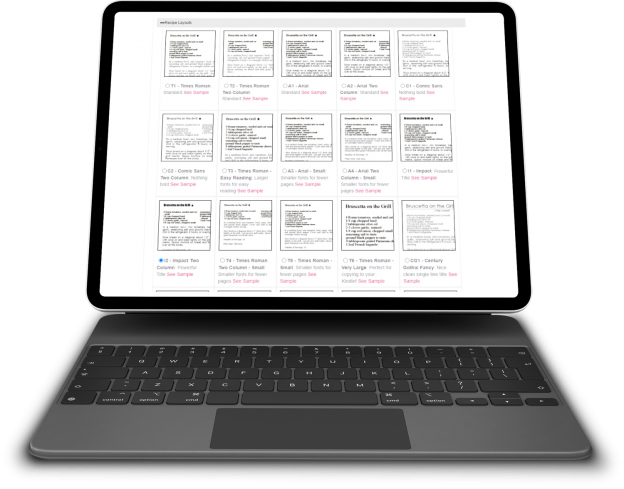
Have you ever had a cake recipe that really needed a specific frosting? Or a meat recipe that required a special sauce? Wouldn’t it be great if a recipe could have sub recipes attached to keep them together?
Many of our FamilyCookbookProject.com editors have asked for the ability to have multiple sections or steps in recipes. We like to listen and have added it! Now you can have up to 5 “sub” recipes or steps within a recipe, each with its own set of ingredients and directions. Example? You have Carrot Cake and you want a section for the “Cake” with its ingredients and directions, then “Cream Cheese Frosting” with another set of ingredients and directions.
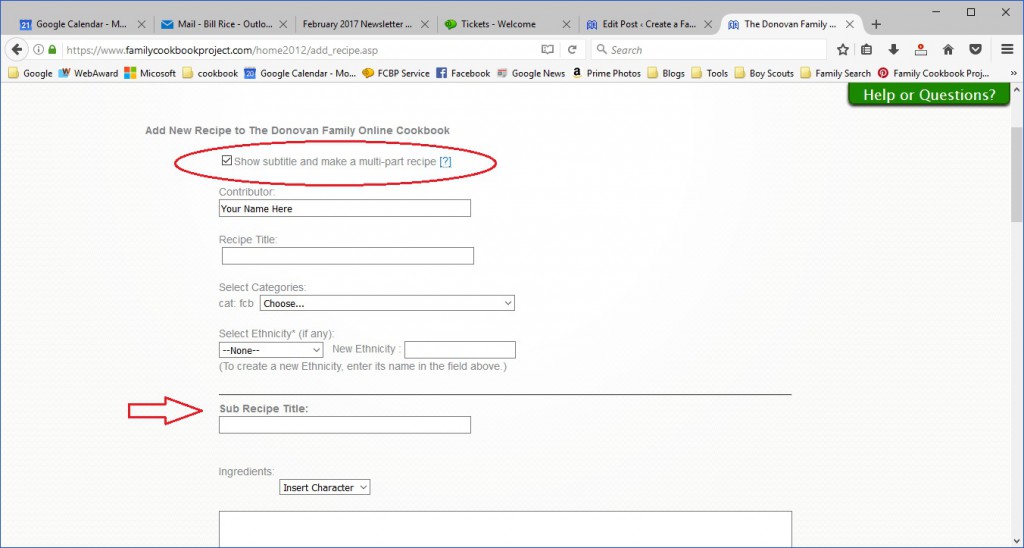
To use this feature, simply go to Add Recipe or Edit an existing recipe. First check the box for “Show subtitle and make a multi-part recipe” right under the contributor field. This will add a field for the sub-recipe title.
Using our example above, here is where you would add your carrot cake ingredients and directions.
Next, click on the green button to “Add new sub recipe”. This will add fields for a second set of sub recipe titles, ingredients and directions for your Cream Cheese Frosting.
You can add up to five sub recipes for your overall recipe.
When you are done, make sure to click on the green button on the bottom of the page to save your recipe before moving on to your next recipe.
Bill Rice is Founder and Co-Publisher of the Great Family Cookbook Project, a website that helps families and individuals collect, preserve and share food memories by creating their own printed personal cookbooks. He is the author of The Wellfleet Oyster Cookbook and the Cape Cod Cocktail Cookbook (Available on Amazon), both created using FamilyCookbookProject.com. He is also editor of the Donovan Family Cookbook, now it’s third printing and is an avid genealogist tracing his family back to the 1600’s.
Follow Family Cookbook Project on Facebook, Instagram, Twitter and Pinterest!

Fundraising Success Story: Here is comments from the editor of a successful cookbook fundraiser using Cookbookfundraiser.com
“We are so thrilled with the outcome of our cookbook project. Originally I had thought that we would do the printing of our school cookbook in a traditional way, as I have more than two dozen years in publication production. Another PTA mom suggested finding an online vendor, and after searching the possibilities, I found your site to be the most user friendly and cost-effective solution”.
“What we liked most was the ease in allowing folks to enter their recipes directly online. From there, we could go in and edit the entered data to be consistent. And at the time of completion, I could go in and manipulate the recipes to fit the pages, making the most of space and economics! You give so many options”.
“The printed project turned out beautifully! Our custom photographs, including the cover, turned out awesome – a real selling point. We got unexpected benefits from extensive media coverage, boosting sales and necessitating a reprint within only a couple of months of our original printing – be sure to order enough up front – the final product has been in serious demand. We made more than $1,500 from our first printing, and expect even more from the 2nd printing.
Thank you, CookbookFundraiser.com!”
– Cheryl Madden Brown, McKee Elementary School PTA, Oakdale, PA
Start your own successful cookbook fundraiser at https://Cookbookfundraiser.com today!
Bill Rice is Founder and Co-Publisher of the Great Family Cookbook Project, a website that helps families and individuals collect, preserve and share food memories by creating their own printed personal cookbooks. He is the author of The Wellfleet Oyster Cookbook and the Cape Cod Cocktail Cookbook (Available on Amazon), both created using FamilyCookbookProject.com. He is also editor of the Donovan Family Cookbook, now it’s third printing and is an avid genealogist tracing his family back to the 1600’s.
Follow Family Cookbook Project on Facebook, Instagram, Twitter and Pinterest!

 One of the real benefits of collecting all of your recipes in your online cookbook on FamilyCookbookProject.com is to be able to share them very easily with friends and family.
Say you have friends over and they really like your split pea soup and want the recipe. All you need to do is go to your cookbook account either on your desktop computer or even on your mobile Mobile phone or tablet and pull up the recipe. Now all you have to do is choose how you want to give it to him.
Email – In the upper right hand corner, you’ll see a box marked email a recipe. Enter your friend’s email here and send them your recipe. It’s that easy!
Posted on Facebook – Wow your friend might like your recipe, so will other friends. You can select the Facebook icon and post your recipe to your Facebook page to be seen by all your friends. Especially if you’ve been adding photos to your recipes, your posts will really stand out and be appreciated by lots of your friends and family.
Posted on Pinterest – Here’s another way to share your recipes if they have photos attached. Pinterest was built around sharing photos and when you share one of your recipes on this social media platform, the photo becomes the pin and people who click on it will see your recipe.
Print your recipe – If your friend simply wants a printed copy of your recipe, it is easy to select the print icon and simply print them a copy and give it to them.
Give them your Family Cookbook – Printing your family cookbook allows you to share all of your recipes with friends and family and is a great gift from the heart.
You also might want to suggest to your friends that they create their own family cookbook account so they can share their recipes as well!
Bill Rice is Founder and Co-Publisher of the Great Family Cookbook Project, a website that helps families and individuals collect, preserve and share food memories by creating their own printed personal cookbooks. He is the author of The Wellfleet Oyster Cookbook and the Cape Cod Cocktail Cookbook (Available on Amazon), both created using FamilyCookbookProject.com. He is also editor of the Donovan Family Cookbook, now it’s third printing and is an avid genealogist tracing his family back to the 1600’s.
Follow Family Cookbook Project on Facebook, Instagram, Twitter and Pinterest!
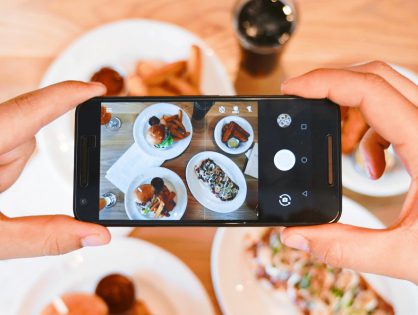
They say a picture is worth a thousand words and with recipes that is especially true.
It’s wonderful to read a list of ingredients and see the potential in a recipe, but to look at the finished product can make your mouth water!
Family Cookbook Project highly recommends adding a photo to every recipe you can in your online cookbook. It helps people to see what to expect when they follow your recipe and gives them a standard to meet when comparing their finished dish to the original.
With the advent of digital cameras built into cell phones, you don’t have to be a professional photographer to take good food photos.
Here are some pointers to help improve your recipe photos:
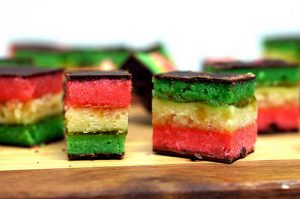 Use Natural Light – Make sure that the light is right – shoot the food either next to a bright window or under a pendant light in the restaurant. Don’t use your camera’s flash! Set your dish near a window and turn off any artificial lights that might be on nearby. Try to photograph with the light at your back or to the side of a dish, so that the shadows are to the side or behind it.
Hold Still – Taking photos inside, even with ample natural light, often means you have to hold the camera very still to keep it from registering hand shake. If you have a tripod, that’s ideal. If you don’t, you can duplicate the tripod effect by resting your elbows on the table or counter and using them to stabilize the camera. Moving the camera when taking a photo will only lead to blurry unusable photos.
Get close to the food! – Don’t stand back three feet and get the food with the stove, the dirty dishes, and all the condiments around it. Move in and get up close and personal, and let the pan…or the plate…or the cutting board fill the frame.
Stage the shot – The food isn’t the only thing in the photo. Using plates, silverware and linens in complementary colors can help your dish come alive. Shoot food on a beautiful plate or on a table with texture and character. The more appetizing the ingredients, the better your photo will be. Plates that contain colored vegetables and/or meat, preferably in light-colored sauces, are often the most appealing to the eye in photos. Also Don’t be Afraid of a mess. A few crumbs or a smear of dressing can be beautiful, if you let them.
Focus on the food – If you are using a DSLR, stop down your lens to f/1.8 or f/2.0 that limits your depth of field to one part of the image only, blurring out everything around the subject, simulating a shot taken with a macro lens. If you are using an iPhone, there are apps, such as Camera+ or VSCO Cam, that will create the same effect. Remember, you want the food to be the main focus, not the background.
Try different angles – Get up over the food and shoot straight down on it. When shooting overheads, if appropriate, try filling up the frame with what’s already on the table such as cups, wine glasses, utensils and moving hands. You can also think in three dimensions. You might not usually serve brownies piled in a vertical column, but stacking any flat food, like pancakes, cookies, or even onion rings, is a great way to show off texture and make the photo more appealing. You can also add dimension to your food photos by showing the dish right after the first bite is taken, or the second and third. These are little details that make a viewer feel like they’ve sat down and are enjoying the meal.
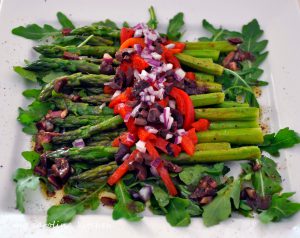 Get Close to Ugly Foods – Some foods, no matter how good they taste, just don’t make good photos. But the closer you get to your subject, the more the visual story becomes about texture and color, rather than pure mouth-watering beauty. Avoid foods that are white and gloppy, such as congealed gravy on white pasty mashed potatoes.
Size Matters – Make sure your camera settings are set for a good sized photo. Small photos look blurry when they are enlarged online. A photo viewed online only has to be 72 dpi (dots per inch, the measure for quality), but if you are going to print your photo, you want it to be at least 300 dpi. 600 pixels wide (a measurement for size) is a good target for minimum photo size.
Using other’s photos – It is important to note that the Internet makes it easy to find photos of recipes already taken. While this might be much easier, the photo still is the property of whoever holds the rights. Don’t always assume that because a photo is on the Internet you can simply use it for your recipe. Make sure you ask permission from the owner before you use it.
Bill Rice is Founder and Co-Publisher of the Great Family Cookbook Project, a website that helps families and individuals collect, preserve and share food memories by creating their own printed personal cookbooks. He is the author of The Wellfleet Oyster Cookbook and the Cape Cod Cocktail Cookbook (Available on Amazon), both created using FamilyCookbookProject.com. He is also editor of the Donovan Family Cookbook, now it’s third printing and is an avid genealogist tracing his family back to the 1600’s.
Follow Family Cookbook Project on Facebook, Instagram, Twitter and Pinterest!


Ever get a gourmet sandwich at a restaurant and wonder how they made it so flavorful? How about a basket of fries with a special dipping sauce? We’re talking about the fancy mayo we can’t get enough of – aioli. But what is aioli in the first place?
Just like mayonnaise, aioli is an emulsion, a mixture of two ingredients that naturally don’t want to mix and are forced together. The oil never truly combines with the rest of the ingredients, but rather becomes suspended in the liquid after being vigorously whisked in, one drop at a time. In mayo’s case, that means oil and a water-based liquid, like vinegar or lemon juice, plus egg yolk.
Aioli, which means “garlic oil” in French, is a different story, yet still similar. The traditional condiment, made with olive oil, rather than mayo’s typical canola, is also an emulsion, but as you can imagine, it’s tough to get oil to combine with raw garlic alone. Since this emulsion was prone to breaking, which would leave you with greasy, unappetizing mush, people started to use egg yolk in aioli, too—the ingredient that helps keep the oil suspended.
With the addition of egg yolk, aioli became more similar to mayonnaise. And over time, aioli and mayo basically became interchangeable terms. Aioli today is often just mayonnaise spiked with a lot of garlic, but it can also refer to any specially seasoned mayo.
While today’s “aioli” may not exactly be true to the original, we’re not complaining—it saves us the elbow grease, plus the flavor can still be just as heavenly – even if you start with store-bought mayonnaise.
There’s no need to spend your whole day trying to perfect an emulsion. You can simply spruce up homemade or store-bought mayonnaise with garlic, citrus juice and any other ingredients you crave in a creamy, decadent dip, sauce or spread.
Here’s a list of ingredients you can try and turn your basic mayo into a tasty aioli:
For the amount of how much to use, it is best to work by taste. Add a little, give it a stir and give it a taste. Repeat until it acquires the taste you enjoy.
Bill Rice is Founder and Co-Publisher of the Great Family Cookbook Project, a website that helps families and individuals collect, preserve and share food memories by creating their own printed personal cookbooks. He is the author of The Wellfleet Oyster Cookbook and the Cape Cod Cocktail Cookbook (Available on Amazon), both created using FamilyCookbookProject.com. He is also editor of the Donovan Family Cookbook, now it’s third printing and is an avid genealogist tracing his family back to the 1600’s.
Follow Family Cookbook Project on Facebook, Instagram, Twitter and Pinterest!