Author: Bill Rice

  • How to Take Great Food Photos for Your Recipes

    How to Take Great Food Photos for Your Recipes

    They say a picture is worth a thousand words and with recipes that is especially true.

    It’s wonderful to read a list of ingredients and see the potential in a recipe, but to look at the finished product can make your mouth water!

    Family Cookbook Project highly recommends adding a photo to every recipe you can in your online cookbook. It helps people to see what to expect when they follow your recipe and gives them a standard to meet when comparing their finished dish to the original.

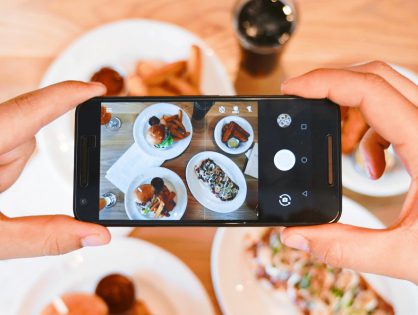
    With the advent of digital cameras built into cell phones, you don’t have to be a professional photographer to take good food photos.

    Here are some pointers to help improve your recipe photos:
    Use Natural Light – Make sure that the light is right – shoot the food either next to a bright window or under a pendant light in the restaurant. Don’t use your camera’s flash! Set your dish near a window and turn off any artificial lights that might be on nearby. Try to photograph with the light at your back or to the side of a dish, so that the shadows are to the side or behind it. 

    Hold Still – Taking photos inside, even with ample natural light, often means you have to hold the camera very still to keep it from registering hand shake. If you have a tripod, that’s ideal. If you don’t, you can duplicate the tripod effect by resting your elbows on the table or counter and using them to stabilize the camera. Moving the camera when taking a photo will only lead to blurry unusable photos. 

    Get close to the food! – Don’t stand back three feet and get the food with the stove, the dirty dishes, and all the condiments around it. Move in and get up close and personal, and let the pan…or the plate…or the cutting board fill the frame.  

    Stage the shot – The food isn’t the only thing in the photo. Using plates, silverware and linens in complementary colors can help your dish come alive. Shoot food on a beautiful plate or on a table with texture and character. The more appetizing the ingredients, the better your photo will be. Plates that contain colored vegetables and/or meat, preferably in light-colored sauces, are often the most appealing to the eye in photos. Also Don’t be Afraid of a mess. A few crumbs or a smear of dressing can be beautiful, if you let them. 

    Focus on the food –  If you are using a DSLR, stop down your lens to f/1.8 or f/2.0 that limits your depth of field to one part of the image only, blurring out everything around the subject, simulating a shot taken with a macro lens. If you are using an iPhone, there are apps, such as Camera+ or VSCO Cam, that will create the same effect. Remember, you want the food to be the main focus, not the background. 

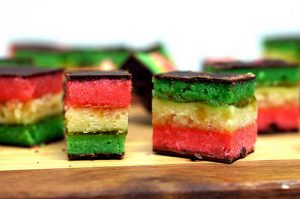
    Try different angles –  Get up over the food and shoot straight down on it. When shooting overheads, if appropriate, try filling up the frame with what’s already on the table such as cups, wine glasses, utensils and moving hands. You can also  think in three dimensions. You might not usually serve brownies piled in a vertical column, but stacking any flat food, like pancakes, cookies, or even onion rings, is a great way to show off texture and make the photo more appealing. You can also add dimension to your food photos by showing the dish right after the first bite is taken, or the second and third. These are little details that make a viewer feel like they’ve sat down and are enjoying the meal.
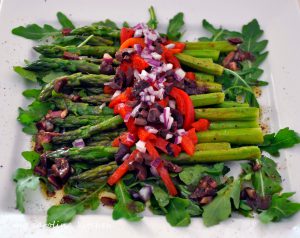
    Get Close to Ugly Foods  – Some foods, no matter how good they taste, just don’t make good photos. But the closer you get to your subject, the more the visual story becomes about texture and color, rather than pure mouth-watering beauty. Avoid foods that are white and gloppy, such as congealed gravy on white pasty mashed potatoes. 

    Size Matters –  Make sure your camera settings are set for a good sized photo. Small photos look blurry when they are enlarged online. A photo viewed online only has to be 72 dpi (dots per inch, the measure for quality), but if you are going to print your photo, you want it to be at least 300 dpi. 600 pixels wide (a measurement for size) is a good target for minimum photo size.

    Using other’s photos – It is important to note that the Internet makes it easy to find photos of recipes already taken. While this might be much easier, the photo still is the property of whoever holds the rights. Don’t always assume that because a photo is on the Internet you can simply use it for your recipe. Make sure you ask permission from the owner before you use it.


    Bill Rice is Founder and Co-Publisher of the Great Family Cookbook Project, a website that helps families and individuals collect, preserve and share food memories by creating their own printed personal cookbooks. He is the author of The Wellfleet Oyster Cookbook and the Cape Cod Cocktail Cookbook (Available on Amazon), both created using FamilyCookbookProject.com. He is also editor of the Donovan Family Cookbook, now it’s third printing and is an avid genealogist tracing his family back to the 1600’s.

    Follow Family Cookbook Project on Facebook, Instagram, Twitter and Pinterest!

  • Homemade Aioli Makes Every Sandwich Better

    Homemade Aioli Makes Every Sandwich Better

    Ever get a gourmet sandwich at a restaurant and wonder how they made it so flavorful?  How about a basket of fries with a special dipping sauce? We’re talking about the fancy mayo we can’t get enough of – aioli. But what is aioli in the first place?

    What Is Aioli?

    Just like mayonnaise, aioli is an emulsion, a mixture of two ingredients that naturally don’t want to mix and are forced together. The oil never truly combines with the rest of the ingredients, but rather becomes suspended in the liquid after being vigorously whisked in, one drop at a time. In mayo’s case, that means oil and a water-based liquid, like vinegar or lemon juice, plus egg yolk.

    Aioli, which means “garlic oil” in French, is a different story, yet still similar. The traditional condiment, made with olive oil, rather than mayo’s typical canola, is also an emulsion, but as you can imagine, it’s tough to get oil to combine with raw garlic alone. Since this emulsion was prone to breaking, which would leave you with greasy, unappetizing mush, people started to use egg yolk in aioli, too—the ingredient that helps keep the oil suspended.

    With the addition of egg yolk, aioli became more similar to mayonnaise. And over time, aioli and mayo basically became interchangeable terms. Aioli today is often just mayonnaise spiked with a lot of garlic, but it can also refer to any specially seasoned mayo.

    While today’s “aioli” may not exactly be true to the original, we’re not complaining—it saves us the elbow grease, plus the flavor can still be just as heavenly – even if you start with store-bought mayonnaise.

    There’s no need to spend your whole day trying to perfect an emulsion. You can simply spruce up homemade or store-bought mayonnaise with garlic, citrus juice and any other ingredients you crave in a creamy, decadent dip, sauce or spread.

    Here’s a list of ingredients you can try and turn your basic mayo into a tasty aioli:

    • Minced raw garlic – The classic.
    • Roasted garlic – Roasting gives the garlic a subtle, buttery, almost caramelized flavor.
    • Sriracha  – This is what is served in most sushi restaurants.
    • Wasabi Cilantro – Another spicy option with an Asian flair
    • Browned Butter and Lemon – Try this on a lobster roll!
    • Rosemary – A wonderfully subtle flavor
    • Roasted Red Pepper – A perfect dip for veggies
    • Sweet Relish – Better known as Tartar Sauce
    • Lemon-Dill – A light and fresh alternative
    • Chimichurri – Left overs from steak night can make a interesting aioli
    • Truffle oil – Perfect for French fries

    For the amount of how much to use, it is best to work by taste. Add a little, give it a stir and give it a taste. Repeat until it acquires the taste you enjoy.


    Bill Rice is Founder and Co-Publisher of the Great Family Cookbook Project, a website that helps families and individuals collect, preserve and share food memories by creating their own printed personal cookbooks. He is the author of The Wellfleet Oyster Cookbook and the Cape Cod Cocktail Cookbook (Available on Amazon), both created using FamilyCookbookProject.com. He is also editor of the Donovan Family Cookbook, now it’s third printing and is an avid genealogist tracing his family back to the 1600’s.

    Follow Family Cookbook Project on Facebook, Instagram, Twitter and Pinterest!

  • How To Get Started With Family Cookbook Project Video

    How To Get Started With Family Cookbook Project Video

    About the Family Cookbook Project

    The Family Cookbook Project helps individuals and families collect and preserve the time-honored recipes that are so important to our family traditions. The website at www.familycookbookproject.com provides step-by-step instructions and online tools to create a valuable family heirloom that preserves recipes and memories for future generation.  Personalized cookbooks are also used by schools, churches and other groups as important fundraisers.


  • Food Related Holidays – January 2023

    Food Related Holidays – January 2023

    It seems that every day is a special day for something. Especially when it comes to our favorite (or not so favorite) foods.

    FamilyCookbookProject.com created a list of special food related holidays that you may not be aware of.

    By the way, it is also National Slow Cooking Month, National Soup Month and National Sunday Supper Month

    For fun, pick some of your favorites and served them on their national day.

    January Food Related National Days

    1 – National Bloody Mary Day

    4 – National Spaghetti Day

    6 – National Shortbread Day

    7 – National Tempura Day

    9 – National Apricot Day

    10 – National Bittersweet Chocolate Day

           National Oysters Rockefeller Day

    11 – National Milk Day

    12 – National Curried Chicken Day

    13 – National Peach Melba Day

    14 – National Hot Pastrami Sandwich Day

    15 – National Bagel Day

           National Strawberry Ice Cream Day

    16 – National Fig Newton Day

    18 – National Peking Duck Day  

    19 – National Popcorn Day

    20 – National Cheese Lover’s Day

    21 – National Granola Bar Day

    22 – National Blonde Brownie Day

    23 – National Pie Day

    24 – National Peanut Butter Day

    27 – National Chocolate Cake Day

    28 – National Blueberry Pancake Day

    30 – National Croissant Day

    31 – National Hot Chocolate Day


    Source: National Day Calendar


    Bill Rice is Co-Founder and Publisher of the Great Family Cookbook Project, a website that helps families and individuals collect, preserve and share food memories by creating their own printed personal cookbooks. He is the author of The Wellfleet Oyster Cookbook (Available on Amazon) and the Cape Cod Cocktail Cookbook, both created using FamilyCookbookProject.com. He is also editor of the Donovan Family Cookbook, now it’s third printing.

    Follow Family Cookbook Project on Facebook, Instagram and Pinterest!

  • Another Happy Family Cookbook Project Editor

    Another Happy Family Cookbook Project Editor

    I can’t even tell you how excited I was to get my box of cookbooks!!! Last January I started looking online for a program to produce a cookbook from my recipes. I wanted them for Christmas for my daughters and daughter-in-laws. I anticipated taking all year typing them up. When I found this program using photographs of the recipe cards I was thrilled! Absolutely brilliant and the process was so slick! I wanted to keep it a secret but worried I would have to ask for help as I’m not that computer savvy, but I did the whole thing myself! It was very simple and definitely earns five stars from me! The finished book is beautiful. My family is beyond thrilled and I look forward to gifting these to my grandchildren as well. Thank you for your program that took me way beyond my expectations.

    — Cindy Jensen, Grandma Cindy’s Cookbook


    Bill Rice is Founder and Co-Publisher of the Great Family Cookbook Project, a website that helps families and individuals collect, preserve and share food memories by creating their own printed personal cookbooks. He is the author of The Wellfleet Oyster Cookbook and the Cape Cod Cocktail Cookbook (Available on Amazon), both created using FamilyCookbookProject.com. He is also editor of the Donovan Family Cookbook, now it’s third printing and is an avid genealogist tracing his family back to the 1600’s.

    Follow Family Cookbook Project on Facebook, Instagram, Twitter and Pinterest!
  • How To Add A Co-Editor To Your Family Cookbook Project

    How To Add A Co-Editor To Your Family Cookbook Project

    With the FamilyCookbookProject.com Publishing System, we recommend that only one person serve as Editor – “too many cooks spoil the soup” so to speak.  You really need one person with full control or you cannot keep up with what might have been changed.

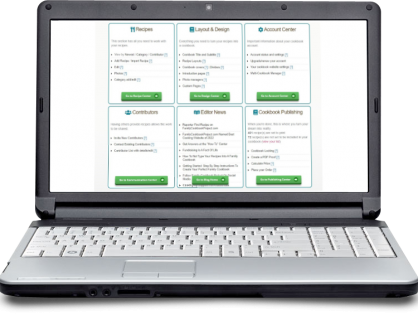
    That said, you have the ability to promote any contributor to the level of Co-Editor.  To do so, go to the Communication Center and click on their name in the list.  Check the box next to their username and update.  The next time they login they will have access to:

    • Editor Activities Menu with all tools
    • Add/Edit any recipe to help with cookbook editing
    • Communication Center – they can promote/demote users as Co-Editors

    We highly recommend allowing only trusted helpers serving as co-editor.

    Here is a quick tutorial video that shows you how:  https://www.youtube.com/watch?v=99NcfrI-PKM


    Bill Rice is Founder and Co-Publisher of the Great Family Cookbook Project, a website that helps families and individuals collect, preserve and share food memories by creating their own printed personal cookbooks. He is the author of The Wellfleet Oyster Cookbook and the Cape Cod Cocktail Cookbook (Available on Amazon), both created using FamilyCookbookProject.com. He is also editor of the Donovan Family Cookbook, now it’s third printing and is an avid genealogist tracing his family back to the 1600’s.

    Follow Family Cookbook Project on Facebook, Instagram, Twitter and Pinterest!

  • Season’s Greetings From Family Cookbook Project

    Season’s Greetings From Family Cookbook Project

    The staff of Family Cookbook Project wishes you a happy and safe holiday season and a joyous New Year!

  • Make Every Sandwich Better with Homemade Aioli

    Make Every Sandwich Better with Homemade Aioli

    Ever get a gourmet sandwich at a restaurant and wonder how they made it so flavorful?  How about a basket of fries with a special dipping sauce? We’re talking about the fancy mayo we can’t get enough of – aioli. But what is aioli in the first place?

    What Is Aioli?

    Just like mayonnaise, aioli is an emulsion, a mixture of two ingredients that naturally don’t want to mix and are forced together. The oil never truly combines with the rest of the ingredients, but rather becomes suspended in the liquid after being vigorously whisked in, one drop at a time. In mayo’s case, that means oil and a water-based liquid, like vinegar or lemon juice, plus egg yolk.

    Aioli, which means “garlic oil” in French, is a different story, yet still similar. The traditional condiment, made with olive oil, rather than mayo’s typical canola, is also an emulsion, but as you can imagine, it’s tough to get oil to combine with raw garlic alone. Since this emulsion was prone to breaking, which would leave you with greasy, unappetizing mush, people started to use egg yolk in aioli, too—the ingredient that helps keep the oil suspended.

    With the addition of egg yolk, aioli became more similar to mayonnaise. And over time, aioli and mayo basically became interchangeable terms. Aioli today is often just mayonnaise spiked with a lot of garlic, but it can also refer to any specially seasoned mayo.

    While today’s “aioli” may not exactly be true to the original, we’re not complaining—it saves us the elbow grease, plus the flavor can still be just as heavenly – even if you start with store-bought mayonnaise.

    There’s no need to spend your whole day trying to perfect an emulsion. You can simply spruce up homemade or store-bought mayonnaise with garlic, citrus juice and any other ingredients you crave in a creamy, decadent dip, sauce or spread.

    Here’s a list of ingredients you can try and turn your basic mayo into a tasty aioli:

    • Minced raw garlic – The classic.
    • Roasted garlic – Roasting gives the garlic a subtle, buttery, almost caramelized flavor.
    • Sriracha  – This is what is served in most sushi restaurants.
    • Wasabi Cilantro – Another spicy option with an Asian flair
    • Browned Butter and Lemon – Try this on a lobster roll!
    • Rosemary – A wonderfully subtle flavor
    • Roasted Red Pepper – A perfect dip for veggies
    • Sweet Relish – Better known as Tartar Sauce
    • Lemon-Dill – A light and fresh alternative
    • Chimichurri – Left overs from steak night can make a interesting aioli
    • Truffle oil – Perfect for French fries

    For the amount of how much to use, it is best to work by taste. Add a little, give it a stir and give it a taste. Repeat until it acquires the taste you enjoy.


    Bill Rice is Founder and Co-Publisher of the Great Family Cookbook Project, a website that helps families and individuals collect, preserve and share food memories by creating their own printed personal cookbooks. He is the author of The Wellfleet Oyster Cookbook and the Cape Cod Cocktail Cookbook (Available on Amazon), both created using FamilyCookbookProject.com. He is also editor of the Donovan Family Cookbook, now it’s third printing and is an avid genealogist tracing his family back to the 1600’s.

    Follow Family Cookbook Project on Facebook, Instagram, Twitter and Pinterest!


  • Family Cookbook Project Wins Best Family Mobile Application

    Family Cookbook Project Wins Best Family Mobile Application

    The Family Cookbook Project (www.familycookbookproject.com) has been named Best Family Mobile Application and Best Cooking and Recipe in the Web Marketing Association’s 11th annual MobileWebAward Competition. The Family Cookbook Project creates personalized cookbooks for individuals, families, church groups and schools. Designed for use on the Apple iPhone or iPad, the free app can be downloaded at https://itunes.apple.com/us/app/family-cookbook-recipes/id503938411?mt=8 or Android https://play.google.com/store/apps/details?id=com.app_fcbrecipes.layout

    The Family Cookbook Project online recipe box allows users to browse and use their recipes. Tools include our blog at your fingertips, latest recipes from our recipe database, notes for in the kitchen, a tip calculator and more! Users can enter their recipes at www.familycookbookproject.com and have access anywhere!

    “The Great Family Cookbook Project is a website dedicated to helping families collect and preserve cherished recipes into a printed cookbook that can be passed down from one generation to the next,” says Chip Lowell, Co-Publisher and Technical Director of the Family Cookbook Project. “However, many people also like to access their recipes on the go from their mobile device. iPhone and iPad users now have an easy to use option to access their recipes”.

    The Family Cookbook Project Website was started as a project in 2003 to help one family collect and organize a family cookbook. Overwhelming feedback from those who used the website led to its continued development and public launch. Currently, more than 106,000 families and groups have started family cookbooks using the website and contributors have entered more than 1.5 million individual recipes.

    “Personalized cookbooks have been around since the 1950s, however the process of collecting and organizing recipes has always been a labor intensive project for the cookbook editor,” says Lowell. “Now it’s easy and cost effective to have your very own cookbook printed. The Family Cookbook Project website provides step by step instructions and tools to help cookbook editors invite others to participate and allow them to enter their favorite recipes directly into the online system. The editor then simply reviews and edits the recipes, selects printing options, and sends the cookbook to be printed. The finished printed cookbooks are then received by the editor in only a few weeks”.

    “We thank Web Marketing Association MobileWebAward judges for recognizing our work. We will continue to develop ways to help families, schools and church groups create both online and printed cookbooks that become treasured heirlooms,” continued Lowell.

    About the Web Marketing Association

    Since 2011, the annual MobileWebAward Competition has been conducted by the Web Marketing Association, an independent organization founded with the purpose of evaluating and recognizing the standard of excellence on the World Wide Web. Award programs run by the Web Marketing Association include the WebAward Competition for Website Development, the Internet Advertising Competition and the MobileWebAwards.

    About the Family Cookbook Project

    The Family Cookbook Project is dedicated to helping individuals and families collect and preserve the time-honored recipes that are so important to our family traditions. The website at www.familycookbookproject.com provides step-by-step instructions and online tools to create a valuable family heirloom. Personalized cookbooks are also used by schools and church groups as important fundraisers. Groups looking to create cookbooks for fundraising efforts, can also check out www.cookbookfundraiser.com.

  • How to Convert iPhone Photos for Use In Family Cookbook

    How to Convert iPhone Photos for Use In Family Cookbook

    Apple is always trying to be seen as innovative, such as introducing “live photos” that seem to move when you view them on your phone or iPad. To accomplish this, they created a new image format called HEIC (High Efficiency Image File Format) that was rolled out in 2017.

    Family Cookbook Project (and most web sites) accept JPG photos only.  If you are having issues with photos not uploading correctly, check to see if the file format on your Mac is HEIC.  That is Apple’s compressed format.  The good news is that it’s easy to convert to JPG.

    Here’s how to convert HEIC to JPG on Mac using Preview:

    1. Open any HEIC image in Preview.
    2. Click File ➙ Export in the menu bar.
    3. Select JPG in the format dropdown and adjust other settings as needed.
    4. Choose Save.

    Here’s how to convert HEIC to JPG on PC using Microsoft Paint:

    1. Open the file in Paint
    2. Go to File>Save As>JPEG picture
    3. Click Save.


    Bill Rice is Founder and Co-Publisher of the Great Family Cookbook Project, a website that helps families and individuals collect, preserve and share food memories by creating their own printed personal cookbooks. He is the author of The Wellfleet Oyster Cookbook and the Cape Cod Cocktail Cookbook (Available on Amazon), both created using FamilyCookbookProject.com. He is also editor of the Donovan Family Cookbook, now it’s third printing and is an avid genealogist tracing his family back to the 1600’s.

    Follow Family Cookbook Project on Facebook, Instagram, Twitter and Pinterest!