
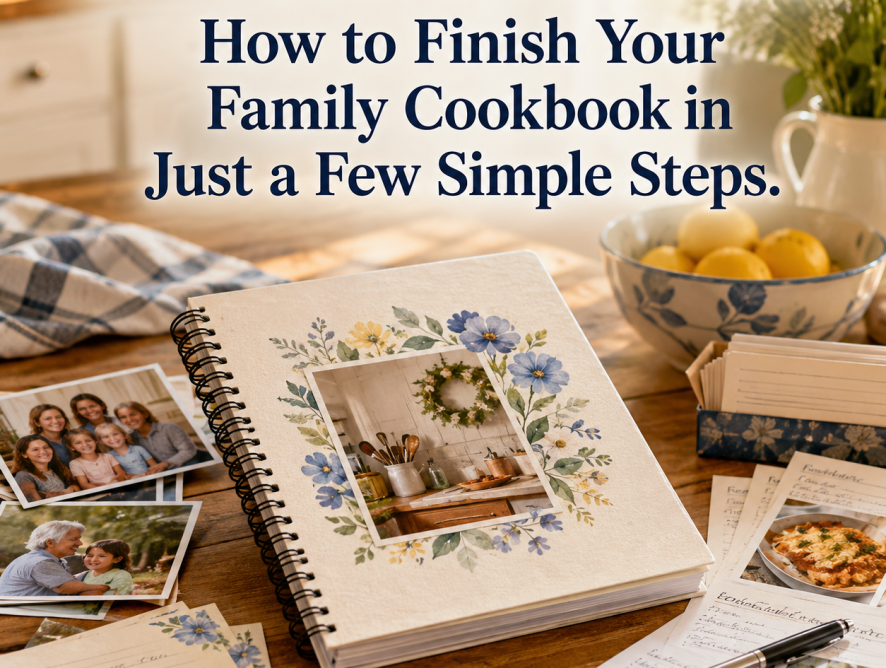
Let’s be real for a minute.
Starting a family cookbook feels exciting. You gather favorite recipes. You think about Grandma’s meatballs, Aunt Linda’s sugar cookies, Dad’s chili, and that one mystery casserole everyone loves but no one can explain. You picture a beautiful printed cookbook sitting on the kitchen counter, ready to be used, shared, splattered, loved, and passed down.
Then life happens.
The cookbook sits unfinished.
Maybe it has been a few months. Maybe it has been a few years. Maybe you started it with great hope, then got distracted by work, family, holidays, laundry, taxes, or the fact that dinner still expects to be made every night. Rude, honestly.
But here’s the good news: you are probably much closer to finishing your family cookbook than you think.
You do not need to create a perfect cookbook. You do not need every recipe your family has ever made. You do not need a museum-level archive of culinary history. You just need to take the next few steps.
And once you do, you can turn your saved recipes into a printed cookbook your family will hold, use, and treasure.
So grab your coffee. Or tea. Or the last cold sip of yesterday’s coffee, because we are not judging here. Let’s walk through how to finish your family cookbook without stress, drama, or a three-ring binder full of panic.
First, Let Go of “Perfect”
This is the big one.
Many family cookbooks stay unfinished because the editor wants everything to be perfect before printing. Every recipe must be checked. Every photo must be found. Every cousin must reply. Every spelling error must be caught. Every category must feel just right.
That sounds nice.
It also sounds like trying to fold a fitted sheet while riding a bicycle.
Perfect is not the goal. Finished is the goal.
A printed family cookbook does not have to include every recipe from every branch of the family tree. It does not have to be the final word on your family’s food history. In fact, many families print one cookbook now and create another version later.
Think of your cookbook as a snapshot of your family at this moment. It captures the recipes, stories, and people you have now. That makes it special.
Could you add more later? Of course. Could you make a second edition in the future? Absolutely. But the recipes you already have deserve to be printed and shared.
Ask yourself this: would your family rather have a printed cookbook with 85 wonderful recipes now, or wait five more years for the “perfect” cookbook with 112 recipes?
Exactly.
Print the cookbook your family can enjoy today.
Step 1: Look at What You Already Have
 Before you add one more thing, take a look at what is already in your cookbook.
You may be surprised.
Many people think, “I barely started.” Then they log in and find dozens of recipes already entered. Some have photos. Some have stories. Some are ready to go. It is like opening the fridge and realizing there is actual food in there. A small miracle.
Start by reviewing your current cookbook.
Look at:
- How many recipes you have
- Which categories already feel full
- Which recipes may need a quick review
- Whether your cookbook already has enough content to print
You may not need much more.
A family cookbook does not have to be huge to be meaningful. A smaller cookbook filled with beloved recipes can be just as special as a large one. Sometimes it is even better because people will use it more.
If your cookbook has appetizers, main dishes, desserts, side dishes, and a few family favorites, you may already have the heart of the book.
Do not measure your cookbook by size alone. Measure it by meaning.
Does it include recipes your family loves? Does it save dishes that might otherwise be forgotten? Does it tell part of your family story?
Then you are on your way.
Step 2: Pick a Finish Line
A cookbook project can feel endless if you never define “done.”
So let’s give it a finish line.
Not a scary finish line. Not one with a marching band and a stopwatch. Just a simple point where you can say, “This is enough. We are ready to print.”
Your finish line might be:
- 50 recipes
- 100 recipes
- One recipe from each family member
- All recipes from one side of the family
- Holiday recipes only
- Grandma’s recipe collection
- Recipes for a reunion, birthday, anniversary, or holiday gift
Pick a goal that feels useful and reachable.
If you already have 72 recipes, maybe your goal is 80. That is just eight more. You can do eight, especially with the Family Cookbook Project Smart Recipe Converter. Eight is not a mountain. Eight is a grocery list with ambition.
If you already have 120 recipes, your goal may not be adding more. Your goal may be reviewing, organizing, and printing.
This is where many cookbook editors get stuck. They think finishing means collecting more. Sometimes finishing means deciding you have enough.
Say it out loud if you need to: “We have enough recipes to make a beautiful cookbook.”
There. See? The kitchen did not explode.
Step 3: Focus on the Must-Have Recipes
Every family has recipes that must be included.
You know the ones.
The chocolate cake someone requests every birthday. The stuffing that only shows up at Thanksgiving. The pasta salad that appears at every cookout. The cookies that disappear before they cool. The soup that made sick days better. The barbecue sauce with a secret ingredient no one admits is ketchup.
Those recipes belong in your cookbook.
Before you chase every possible missing recipe, make a short must-have list.
Ask:
- Which recipes would people miss if they were not included?
- Which dishes are part of our family story?
- Which recipes are at risk of being lost?
- Which ones do people ask for again and again?
- Which recipes connect us to someone we love?
That list gives you direction.
You do not need to include every random recipe someone clipped from a magazine in 1987. Unless it is amazing. Or unless there is a note on it that says, “Tom loved this.” Those details matter.
Focus on the recipes with emotional weight. Those are the ones that turn a cookbook from a list of ingredients into a family keepsake.
Step 4: Ask for Help, But Keep It Simple
If you need more recipes, ask your family for help.
But make it easy for them.
Do not send a message to your contributors that says, “Please send all your favorite recipes, family stories, photos, kitchen memories, and any related historic notes by Friday.”
That sounds like homework. People avoid homework. Even adults. Especially adults.
Instead, ask for one specific thing.
Try this:
“Hi everyone! I’m finishing our family cookbook and would love one favorite recipe from you. It can be a dinner, dessert, holiday dish, or anything your family loves. Please send it this week if you can. I’d love to include you.”
That feels doable.
You can also ask one person at a time. Some family members respond better when the request feels personal.
“Hi Aunt Mary, I’m finishing the cookbook and would love to include your banana bread recipe. Could you send it to me?”
That is much better than shouting into the family group chat and hoping someone answers between memes and birthday reminders.
You can also remind people that the recipe does not have to be fancy. Family recipes are often simple. They are loved because they show up at the right time with the right people around the table.
A good recipe does not need truffle oil and a dramatic backstory. Sometimes it just needs butter, noodles, and someone saying, “This is how Mom made it.”
Step 5: Use Photos Where You Have Them
Photos make a family cookbook feel personal.
But here is the key: you do not need a photo for every recipe.
Please release yourself from that idea.
A cookbook with some photos is still beautiful. A cookbook with no photos can still be useful and loved. Photos are wonderful, but they should not stop you from printing.
Use what you have.
You might include:
- Family photos
- Holiday meal photos
- Pictures of recipe cards
- Photos of finished dishes
- Old kitchen snapshots
- Wedding, reunion, or birthday photos
- Pictures of the person known for a recipe
A photo of Grandma standing by the stove may mean more than a perfect picture of her apple pie. People connect to faces, places, and memories.
And if the photo is not perfect? That is fine.
A slightly blurry family photo can still bring a big smile. In fact, sometimes the imperfect ones feel the most real. Life is not a stock photo. Nobody’s Thanksgiving table looks that calm for more than seven seconds.
Add photos where they add warmth. Skip them where they cause stress.
Step 6: Add Personal Notes to Bring Recipes to Life
One of the best parts of a family cookbook is the story behind the recipe.
A personal note can turn a simple recipe into something special.
For example:
“This was Grandpa Joe’s favorite Sunday dinner.”
Or:
“Mom made this every Christmas Eve, and we still argue over who gets the corner piece.”
Or:
“This recipe came from our neighbor Mrs. Wilson, who never measured anything but somehow made everything taste perfect.”
These notes do not need to be long. One or two sentences can make a big difference.
You can add notes about:
- Who made the recipe
- When your family served it
- Why people loved it
- Funny cooking memories
- Ingredient tips
- Changes made over time
- Family traditions tied to the dish
Do you need a story for every recipe? Nope.
Again, we are not building a courthouse record. We are making a cookbook.
Add notes where you can. They give your cookbook heart.
Step 7: Organize the Cookbook by Category
A cookbook feels easier to use when recipes are organized in a clear way.
Most family cookbooks work well with simple categories such as:
- Appetizers
- Soups and Salads
- Main Dishes
- Side Dishes
- Breads
- Desserts
- Cookies
- Holiday Favorites
- Family Favorites
You can keep it classic or create custom categories that fit your family.
Maybe your family needs a “Grandma’s Best” section. Maybe you need “Game Day Recipes” or “Beach Week Favorites.” Maybe you need “Recipes Kids Actually Eat,” which, let’s be honest, may include three foods and a dream.
The goal is to help people find what they want.
Try not to overthink it. If a recipe could fit in two places, pick one and move on. No one will call the cookbook police.
Simple categories make your cookbook easy to browse, easy to cook from, and easy to enjoy.
Step 8: Review Without Getting Stuck
At some point, you need to review your recipes.
But review does not mean rewrite every recipe from scratch.
Look for the basics:
- Is the title clear?
- Are the ingredients listed?
- Are the directions included?
- Is the oven temperature there, if needed?
- Is the cooking time listed, if known?
- Does the recipe make sense?
That is enough for most recipes.
You may find a recipe that says, “Bake until done.” Ah yes, the classic family cooking instruction. Very clear. Very mysterious. Very “Grandma knew, and now we must guess.”
When you find one like that, do your best. Add a note if needed. For example:
“Original recipe says ‘bake until done.’ We suggest checking after 30 minutes.”
That keeps the charm while helping the next person.
Do not let one unclear recipe stop the whole cookbook.
You can also print recipes as they were written if that feels right. Handed-down recipes often carry the voice of the person who wrote them. A little odd phrasing can be part of the charm.
Review for clarity, not perfection.
Step 9: Choose a Cover That Makes You Smile
The cover sets the mood for your cookbook.
It does not need to be fancy. It needs to feel right.
You might choose a cover that feels:
- Warm and traditional
- Bright and modern
- Holiday-themed
- Family-focused
- Elegant
- Fun and casual
You can create a custom cover using a family photo, a food photo, or a design that fits your theme.
If you feel stuck, ask yourself: “Who is this cookbook for?”
If it is a gift for family, a warm family photo may be perfect. If it is a holiday cookbook, a festive cover may work best. If it is a collection of treasured recipes from one person, you may want their photo on the cover.
The right cover makes people want to open the book.
And when they do, they will find something far better than a pretty design. They will find recipes that connect them to people they love.
Step 10: Preview the Cookbook
Before you print, preview your cookbook.
This step helps you catch small issues before the book goes to print.
Look through the pages and check:
- Recipe titles
- Category order
- Page flow
- Photos
- Personal notes
- Cover design
- Any obvious typos
This is also the moment when the project starts to feel real.
You are no longer just “working on a cookbook.” You are looking at the book your family will hold.
That is a big deal.
Try to review it with fresh eyes. You may want to ask one trusted person to look it over too. Choose someone helpful, not someone who will turn a comma into a family crisis.
You want a second set of eyes, not a Supreme Court hearing.
Step 11: Order Your Printed Copies
Once your cookbook looks good, take the step that matters most.
Print it.
You can start with one copy if you want to review it in person. Holding the cookbook often gives you a new sense of what you have created.
You may notice a small change you want to make. That is normal. Many people order a proof or first copy, review it, and then order more for family members.
But do not let the first printed copy scare you. It is exciting. You can order additional copies at any time.
When you hold the cookbook, you see the project in a whole new way. It becomes real. It becomes a gift. It becomes something people can use in their kitchens.
A digital recipe collection is helpful. A printed cookbook is different.
A printed cookbook can sit on a counter. It can be opened by a child. It can be wrapped as a gift. It can be passed around at a reunion. It can collect notes, splatters, and memories.
It becomes part of family life.
Why Printing Matters
You may wonder, “Why print? The recipes are already online.”
Fair question.
Online recipes are useful. But printed cookbooks create a different feeling.
A printed cookbook is easy to share with people who do not use the website often. It makes a beautiful gift. It keeps recipes in one place. It gives family members something they can hold and use.
It also helps protect recipes from being lost in the shuffle of daily life.
Think about how many things live on phones, computers, and old email accounts. Photos. Notes. Recipes. Messages. Important stuff hides everywhere.
A printed cookbook brings your best family recipes out of the digital pile and into the real world.
It says, “These matter.”
That is powerful.
It also makes cooking more fun. There is something special about opening a cookbook and seeing a recipe from someone you love. It feels personal. It feels warm. It feels like they are in the kitchen with you, gently reminding you not to burn the rolls.
Or loudly reminding you. Depends on the relative.
Make It a Gift
A printed family cookbook makes a wonderful gift because it feels personal.
It is not another sweater. It is not another candle. It is not another gadget that comes with a charging cord and mild confusion.
It is a gift with meaning.
Family cookbooks are perfect for:
- Holidays
- Birthdays
- Weddings
- Anniversaries
- Family reunions
- Mother’s Day
- Father’s Day
- Graduation gifts
- Memorial keepsakes
- Housewarming gifts
You can give the same cookbook to many people, and each person may connect with it in a different way.
Some will cook from it. Some will read it like a memory book. Some will put it on a shelf and treasure it. Some will spill sauce on it within a week, which is honestly a sign of love.
Cookbooks are meant to be used.
Do Not Wait for Everyone
This may sound a little bold, but here it is:
Do not wait forever for every family member to send a recipe.
There. We said it.
Some people will send recipes right away. Some will need reminders. Some will promise to send one and then vanish like a sock in the dryer.
That does not mean your cookbook should stay unfinished.
Set a deadline. Give a friendly reminder. Then move forward.
You can always add more recipes in a future edition. But you cannot enjoy a cookbook that never gets printed.
The family members who did contribute will be glad to see it finished. The ones who missed the deadline may even feel inspired to send recipes next time.
Progress has a funny way of waking people up.
You Are Closer Than You Think
Here is the truth: your cookbook does not have to be perfect to be priceless.
It just has to be finished.
The recipes you have already gathered can become something real. Something useful. Something your family will love.
So take a look at your cookbook today. See what is there. Pick your finish line. Add what matters most. Review it. Choose a cover. Print a copy.
You may be only a few simple steps away from holding your family cookbook in your hands.
And when that printed cookbook arrives, you will be glad you finished.
Your family will be glad too.
Bill Rice is Founder and Co-Publisher of the Family Cookbook Project, the leading online cookbook publisher with a website that helps families and individuals collect, preserve and share food memories by creating their own printed custom cookbooks. He is the author of The Wellfleet Oyster Cookbook and the Cape Cod Cocktail Cookbook (Available on Amazon), both created using FamilyCookbookProject.com. He is also editor of the Donovan Family Cookbook, now its third printing and is an avid genealogist tracing his family back to the 1600’s.
Follow Family Cookbook Project on Facebook, Instagram, X (Twitter) TikTok, YouTube and Pinterest!