
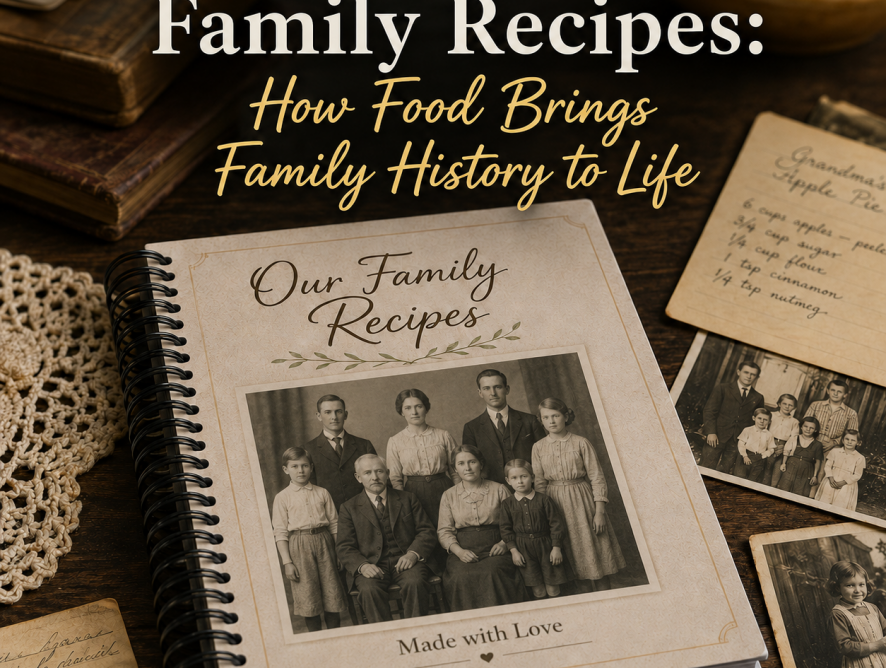
Genealogy often begins with names, dates, records, and family trees. But family history becomes much more meaningful when we understand how people lived, gathered, celebrated, and cooked. Recipes help bring ancestors to life in a way that documents alone cannot.
A handwritten recipe card, holiday dish, regional specialty, or family cooking tradition can reveal where a family came from, what ingredients were available, how traditions moved across generations, and which meals brought people together.
A genealogy-inspired family cookbook combines recipes, photos, family stories, handwritten notes, regional traditions, and memories into one printed keepsake. For genealogists, it becomes more than a cookbook. It becomes a family history document future generations can read, cook from, and pass along.
Recipes Add Heart to Family History
Genealogy records provide the facts of family history, but recipes provide texture and emotion. They show what people ate, what they celebrated, what they valued, and how traditions survived across generations.
Link to How Family Recipes Help Genealogists Bring Ancestors to Life, which explains that genealogy is about understanding people, not just proving lineage, and that a cookbook can preserve human details before they disappear.
Then link to Genealogy and Culinary Heritage: Creating a Family Cookbook for Future Generations, which focuses on handwritten recipe cards and the memories carried by old recipe boxes.
Preserve Handwritten Recipe Cards
Handwritten cards are especially valuable to genealogists because they preserve handwriting, notes, stains, corrections, and personality. Including scanned or photographed cards in a family cookbook gives future generations a visual connection to the person who wrote or used the recipe.
For recipe-card preservation, link to Grandma’s Secret Cookie Recipes: Preserving Family Traditions, Grandma’s Recipes Preserved – 1,000 and Counting!, and Favorite Recipes From Grandma Preserved.
Connect Recipes to Places and Migration
Food often travels with families. A recipe may reflect a country of origin, a regional tradition, a farming community, a coastal town, or an immigrant story. A cookbook can include notes about where recipes came from and how they changed as the family moved.
Link to Turn Local Flavor Into a Legacy: Create a Regional Cookbook for Family and Friends. This article supports the idea that food traditions can preserve the character of a place as well as a family.
Collect Recipes From Living Relatives
Interview relatives about the foods they remember from childhood, holidays, family gatherings, and special occasions. Even if they do not have written recipes, their memories can help reconstruct family food traditions.
Link to Tips for Collecting and Organizing Recipes from Multiple Family Members, which explains how to involve multiple relatives in a cookbook project. Also link to 6 Ways to Enter Your Recipes into a Family Cookbook and How to Dictate a Recipe Into Your Family Cookbook Project, since older relatives may prefer talking through recipes instead of typing them.
Organize Recipes by Family Branch or Generation
A genealogy cookbook does not have to follow standard meal categories. It can be organized by ancestor, family branch, generation, region, holiday, or contributor. Custom categories make it easier to structure the cookbook around family history rather than just food type.
Link to Customizing Your Family Cookbook Recipe Categories, which notes that editors can change categories and even organize sections by family member.
Also link to Organizing Your Recipes in Your Family Cookbook for practical guidance on structuring a cookbook.
Add Photos, Stories, and Documents
Genealogy cookbooks can include old family photos, kitchen pictures, reunion photos, handwritten cards, newspaper clippings, short biographies, and memories. These elements help readers understand the people behind the recipes.
Link to Recipe Layout Tool Upgrade on FamilyCookbookProject.com because it explains how layout controls recipe formatting and photo placement. For covers, link to Customizing Your Family Cookbook Cover and Family Cookbook Project Introduces New Cover Editing Tool.
Include Recipes From Special Family Events
Family events often generate meaningful recipe collections. Wedding showers, reunions, holidays, memorials, and anniversaries can all become opportunities to gather recipes and stories.
Link to How To Make A Bridal Shower Cookbook and How To Create a Mini Cookbook. These support the idea that genealogy cookbooks can begin with smaller, event-focused projects.
Create a Keepsake Future Generations Can Use
Unlike many genealogy documents, a cookbook is meant to be opened, read, cooked from, and shared. It gives future generations a way to experience family history through taste, smell, and tradition.
Before printing, link to How To Get Your Cookbook Ready To Print. If the genealogy cookbook becomes large, link to How Much Does Printing a Family Cookbook Cost? and Pro Tip: Space Saving Options To Lower Printing Cost.
Family history is more than names on a chart. Preserve the meals, memories, handwriting, and traditions that helped shape your family by creating a genealogy-inspired family cookbook.
Bill Rice is Founder and Co-Publisher of the Family Cookbook Project, the leading online cookbook publisher with a website that helps families and individuals collect, preserve and share food memories by creating their own printed custom cookbooks. He is the author of The Wellfleet Oyster Cookbook and the Cape Cod Cocktail Cookbook (Available on Amazon), both created using FamilyCookbookProject.com. He is also editor of the Donovan Family Cookbook, now its third printing and is an avid genealogist tracing his family back to the 1600’s.
Follow Family Cookbook Project on Facebook, Instagram, Twitter TikTok, YouTube and Pinterest!