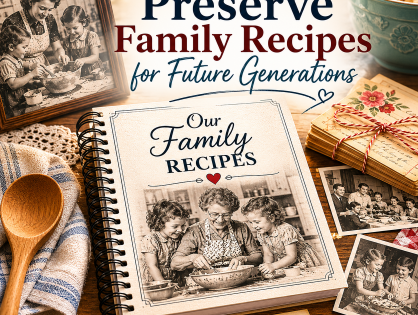
Family recipes are some of the most personal heirlooms a family can have. A handwritten recipe card may include more than ingredients and directions. It may preserve a grandmother’s handwriting, a parent’s cooking notes, a holiday tradition, or the memory of a dish that always brought everyone to the table.
The problem is that family recipes are easy to lose. Paper fades. Cards tear. Recipe boxes get misplaced. Digital files disappear. When recipes are not collected and preserved, families can lose more than cooking instructions. They can lose stories, traditions, and connections to past generations.
Creating a family cookbook gives those recipes a permanent home. Recipes can be typed, copied, dictated, photographed, scanned, organized, and printed into a keepsake cookbook that can be shared with children, grandchildren, cousins, siblings, and future family cooks.
Why Family Recipes Are Worth Preserving
Family recipes connect generations. They remind us of holidays, family dinners, cultural traditions, and the people who prepared food with love. Preserving these recipes helps make sure that future generations do not just know family names, but also understand the foods, flavors, and traditions that shaped family life.
A strong supporting article for this section is Genealogy and Culinary Heritage: Creating a Family Cookbook for Future Generations, which explains how handwritten recipe cards and recipe boxes carry family memories and are at risk of being lost over time.
You can also link to How Family Recipes Help Genealogists Bring Ancestors to Life, which positions recipes as a way to understand family history beyond dates and documents.
Save Handwritten Recipe Cards
Handwritten recipe cards are valuable because they preserve the original voice and personality of the cook. When possible, save the original card, photograph or scan it, and include the image in your cookbook. This preserves the handwriting while still allowing the recipe to be typed clearly for easy cooking.
For families preserving cookie recipes, holiday recipes, or grandmother’s specialties, link to Grandma’s Secret Cookie Recipes: Preserving Family Traditions. You can also point readers to Grandma’s Recipes Preserved – 1,000 and Counting!, which reinforces the idea that recipes from grandmothers, nonnas, omas, grannies, and grams deserve to be saved.
Collect Recipes Before They Disappear
The best time to collect family recipes is before they are lost. Ask older relatives for their favorite dishes, holiday recipes, everyday meals, and the “recipes they know by heart.” Some of the most important family recipes may never have been written down, so interviews and conversations can be just as important as recipe cards.
The article Tips for Collecting and Organizing Recipes from Multiple Family Members fits naturally here because it explains how to collect recipes from relatives, set expectations, and add stories and photos.
For families who want multiple ways to capture recipes, link to 6 Ways to Enter Your Recipes into a Family Cookbook and How to Dictate a Recipe Into Your Family Cookbook Project.
Preserve the Story Behind Each Recipe
A recipe becomes more meaningful when readers know who made it, where it came from, and why it mattered. Include short memories, notes, or introductions with important recipes. Even a few sentences can turn a simple dish into a piece of family history.
For heritage-focused families, link to How Family Recipes Help Genealogists Bring Ancestors to Life. For families preserving local or regional food traditions, link to Turn Local Flavor Into a Legacy: Create a Regional Cookbook for Family and Friends.
Organize Recipes for Future Generations
Preserved recipes should be easy to find and use. Organize the cookbook by category, contributor, family branch, holiday, or generation. Custom categories and subcategories help families create a structure that reflects their own history rather than forcing every cookbook into the same format.
Link to Organizing Your Recipes in Your Family Cookbook and Customizing Your Family Cookbook Recipe Categories. The custom categories article is especially useful because it notes that categories can be changed for specialty cookbooks and can even be organized by family member.
Add Photos and Family Memories
Photos make a recipe collection feel alive. Include pictures of relatives, gatherings, handwritten cards, finished dishes, old kitchens, and holiday tables. These images give future generations a sense of the people and places behind the recipes.
For design and photo placement, link to Recipe Layout Tool Upgrade on FamilyCookbookProject.com, which explains that recipe layouts control fonts, directions, ingredients, columns, and photo placement.
If families want the cover itself to feature a treasured image, link to Customizing Your Family Cookbook Cover and Family Cookbook Project Introduces New Cover Editing Tool.
Print and Share the Cookbook
Digital storage is useful, but printed cookbooks are easier to share, gift, and preserve. A printed family cookbook can be used in the kitchen, displayed on a shelf, given at holidays, or passed down as a family heirloom.
Before printing, link to How To Get Your Cookbook Ready To Print. For families concerned about cost, link to How Much Does Printing a Family Cookbook Cost? and Pro Tip: Space Saving Options To Lower Printing Cost.
Do not let your favorite family recipes fade away in a drawer. Create a family cookbook that preserves the recipes, handwriting, photos, and stories your family will treasure for generations.
Bill Rice is Founder and Co-Publisher of the Family Cookbook Project, the leading online cookbook publisher with a website that helps families and individuals collect, preserve and share food memories by creating their own printed custom cookbooks. He is the author of The Wellfleet Oyster Cookbook and the Cape Cod Cocktail Cookbook (Available on Amazon), both created using FamilyCookbookProject.com. He is also editor of the Donovan Family Cookbook, now its third printing and is an avid genealogist tracing his family back to the 1600’s.
Follow Family Cookbook Project on Facebook, Instagram, Twitter TikTok, YouTube and Pinterest!